
Understanding the science behind artistic processes and tools will help you and your students experience more success with traditional techniques. You’ll also be able to guide new insights for innovative connections. Everyday art room items like paper, pencils, erasers, and the good old color wheel are constants that rarely get attention. Let’s get curious about these seemingly mundane staples and discover that they’re actually low-key fascinating!
Investigate the eight curious questions below about everyday art supplies!

1. Why does watercolor paper have a smooth side and a textured side?
In the manufacturing process, the paper pulp sits on a screen to allow the water to drain. The side of the paper facing the screen is the wire side and tends to have a smoother surface. The wire side is ideal for work with fine details, smooth flowing lines, and even washes of color.
The other side of watercolor paper gets pressed with felt pads or rolled with dandy rolls during production. It’s called the felt side and has a bumpy, irregular texture. This surface is ideal for artists who want to create more painterly work. The indentations allow for the water and pigment to pool and settle. This also makes it easier to use subtractive methods, such as lifting paint off the surface.
2. Why do colored pencils and crayons stop working on areas that are already colored?
Pencils, colored pencils, crayons, and oil pastels all rely on friction to make their marks. All paper has some amount of texture, and this is the tooth of the paper. The tooth of the paper helps to break off microscopic bits of the drawing media, which then sit on the paper. After intense coloring, the wax and other materials from your drawing media can build up, reaching a point where the paper is fully smoothed over and saturated. At this point, it can no longer accept more pigment.
Erasing these marks can bring back some of the roughness of the surface, so you can draw or color more. You can even erase crayons and oil pastels to some extent, as most of the color sits on the surface rather than soaking into the fibers of the paper.
3. How does an eraser remove marks from paper?
Speaking of erasing, just like a lot of drawing media, erasers rely on friction. As you rub an eraser over the surface of a drawing, the friction generates heat. This heat causes the synthetic rubber to soften, making it stickier than the paper. The pigment sticks to the eraser and lifts off the surface of the paper. Then, as the surface of the eraser gets covered in pigment, it crumbles to release the dirty pieces, revealing a fresh, clean surface on the eraser.
Kneaded erasers don’t need the friction and heat to become more sticky than the paper. The unvulcanized rubber compound used in kneaded erasers acts as a low-tack adhesive. It’s just strong enough to lift the pigment off the surface of the paper. Interestingly, while we think of kneading the eraser as cleaning it, the kneading action simply dilutes the concentration of pigment, spreading it throughout the entire eraser. Consequently, a kneaded eraser can eventually reach a saturation point where it can no longer be “cleaned.”

4. Why are erasers pink?
Today, erasers are made using mostly synthetic materials, so companies can make them in any color. The Eberhard Faber Pencil Co. originally made erasers in the early 1900s using a red or pink pumice. In 1916, they launched Pink Pearl, which was immensely popular. Now, manufacturers often add a pink dye to make their erasers fit people’s expectations.
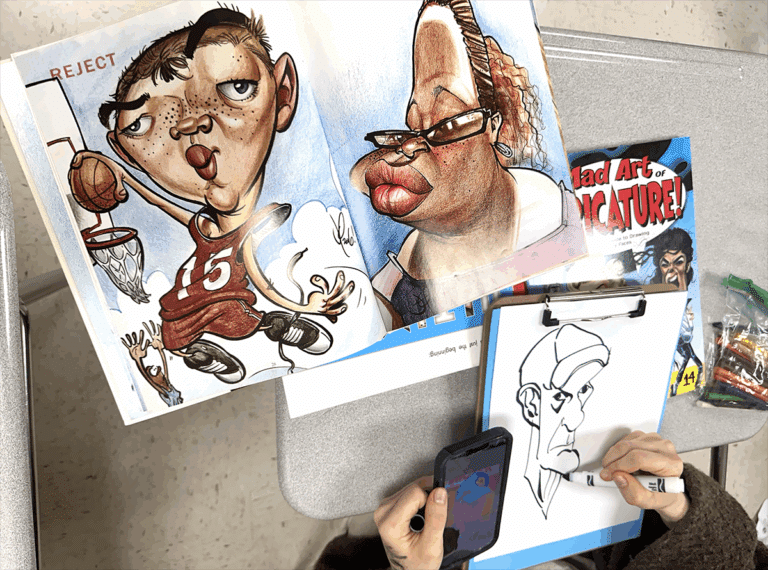
Check out FLEX Curriculum for lessons that will show your students how amazing a humble eraser can be. You’ll find wonderful drawing lessons for students of all ages, like Reductive Cartoon Portraits, which challenges students to use erasers as a drawing tool to make expressive faces.
5. Why is yellow the standard color for pencils?
The yellow pencil became all the rage after the 1889 World’s Fair in Paris. In the 19th century, there was a big deposit of high-quality graphite in Siberia near the Chinese border. Hardtmuth, a Czech pencil company, decided to market its pencils with yellow lacquer because yellow is associated with royalty, wealth, and prosperity in China. The pencil was a success, and other pencil companies like Faber and Dixon Ticonderoga followed suit.

6. If HB is the middle of the continuum, why is it number 2?
There are two rating systems for pencils. Most of the world uses the international system, which is a continuum from H to B. The H means it has hard graphite and produces lighter marks, whereas the B represents soft graphite, which leaves bold, darker marks. HB represents the middle of that range. The higher the number next to an H or B, the further it is on that end of the spectrum. The American system is 1-4. The lower the number, the softer the lead. Number 2 represents the middle of the range. So, a 2H or a 2B are different from a #2 pencil.
7. Why are there holes in marker and pen caps?
We put caps on markers and pens to prevent the ink from drying out. It seems counterproductive to have holes in the caps. The holes are required so that if a person swallows a cap, they can still breathe while the cap is in their throat.
8. Why are there six colors in the color wheel but seven in the rainbow?
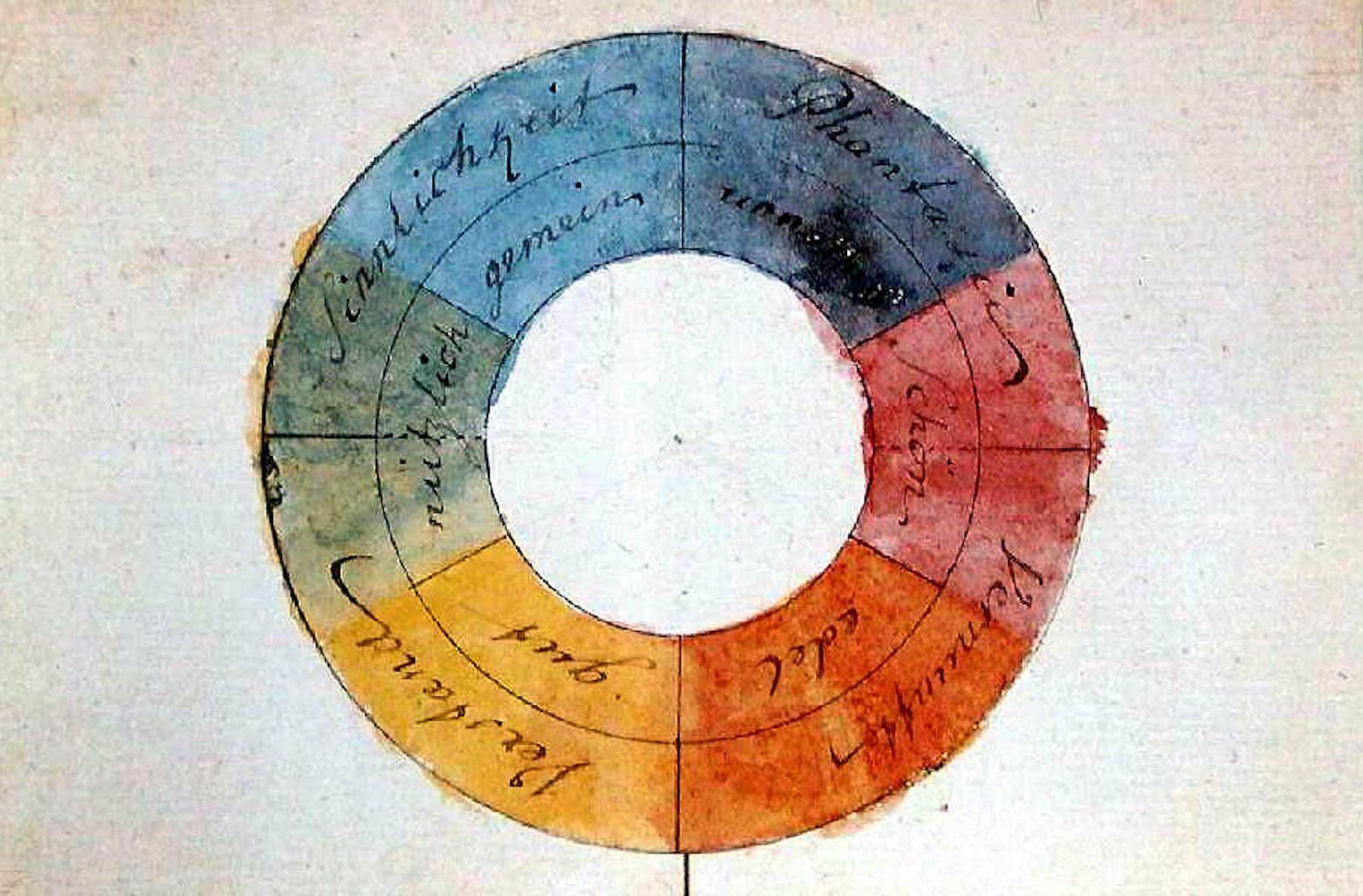
There’s more than one way to make a color wheel. Sir Isaac Newton recognized that colors blend into each other. He could have divided the visible light spectrum into a million different colors. Instead, he opted for seven because he thought it would make sense for the structure of light to align with the structure of sound. There are seven notes in the musical scale, so he put seven colors in his light spectrum and his color wheel.
In 1810, Johann Wolfgang von Goethe wrote Theory of Colours and introduced the symmetrical six-color wheel with the traditional primary and secondary colors. In the 1860s, Louis Prang came up with the Artist’s Color Wheel, adding in tertiary colors to bring the count up to twelve.
To make it even more confusing, there are different versions of the color wheel and different sets of primaries for different media. Luckily, FLEX has wonderful resources like the Beginner Color Vocabulary handout, a CMYK and RGB Color Guide, and a Color Mixing Pre-Test that are all teacher-created and classroom-ready. If you want to do a deep dive into color, check out the Color Theory Basics Pack in PRO Learning.

The next time a student asks, “Why does this happen?” or “What would happen if…?”—lean into that curiosity! Art is full of tiny mysteries hiding in plain sight that can easily turn into big learning moments. From the tooth of watercolor paper to the color of a pencil, there are so many interesting facts about things we use every single day. When we take time to uncover the answers, students gain a depth of knowledge, and we encourage their inquisitiveness. Keep asking, keep exploring, and keep finding the magic in your art studio!
What burning questions do you still have about the art materials in your classroom?
What odd and interesting insights about art materials blow your students’ minds?
To share your curious questions or discoveries with other art teachers, join us in The Art of Ed Community!
Magazine articles and podcasts are opinions of professional education contributors and do not necessarily represent the position of the Art of Education University (AOEU) or its academic offerings. Contributors use terms in the way they are most often talked about in the scope of their educational experiences.