

When students discover the natural connection between printmaking and math, magic happens. Students who adore art begin to see math not as intimidating, but as an exciting, empowering tool for problem-solving and design. Students who love math light up as they apply their logical thinking in creative, hands-on ways. With a little intentionality, show students how both are about thinking, solving, experimenting, and innovating.
Did you know? Printmaking and math are already best friends!
From the earliest days of printmaking, artists relied on math to succeed. Ancient woodblock printers needed precision to carve repeating patterns. Renaissance engravers like Albrecht Dürer used geometry, ratios, symmetry, and impeccable measurements to create stunning prints rooted in mathematical thinking.
Because students take classes in different subjects, it’s easy for them to keep them in separate boxes. Remind them that math doesn’t live in the calculator and art doesn’t float in a cloud of inspiration. When you put printmaking and math side by side, you make space for artists to think logically and mathematicians to create boldly. Students will discover that these subjects speak the same language: precision, pattern, and process. Plus, you offer a rare opportunity to turn abstract math concepts into something tactile, meaningful, and beautiful.
Here are some amazing ways printmaking and math naturally connect:
- Spatial Reasoning
Students strengthen their ability to mentally rotate, flip, and manipulate shapes. They also practice identifying positive and negative shapes. - Proportions and Scaling
Resizing an image to fit a plate reinforces proportion and scale. - Measurement Accuracy
Artists maintain consistent, clean prints and editions through precise registration techniques. - Pattern Recognition
Designing tessellations or radial symmetry encourages students to recognize and build patterns. - Problem-Solving and Sequencing
Every decision in multi-layer prints builds reasoning and planning skills akin to coding and procedural logic. - Fractions and Ratios
Blending inks provides hands-on opportunities to calculate color mixing ratios.
Save these four cool printmaking project ideas that celebrate math!
1. Symmetry Print Series
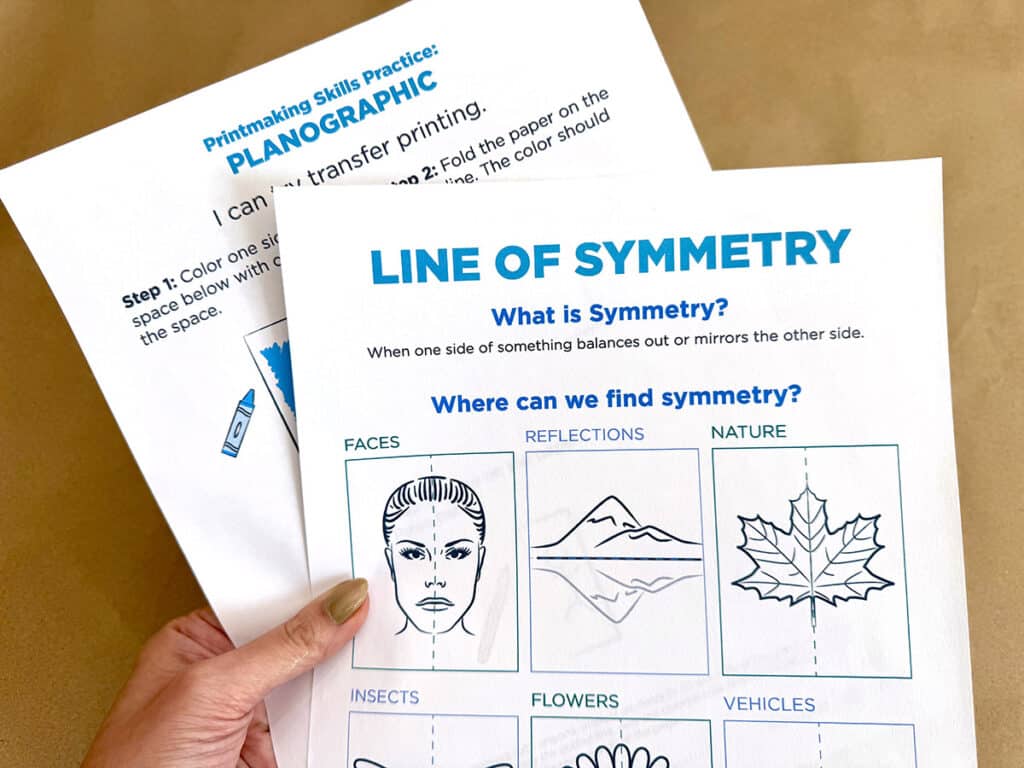
Students explore symmetry by folding paper to sketch mirrored designs, then carving them into foam or rubber plates. The final prints reveal lines of reflection and balance. Students can print multiple versions in different orientations to explore how images change when rotated. Check out the Exploring Symmetry in Printmaking Lesson in FLEX Curriculum to do this project with younger artists, or use it as a short, introductory activity for older students.
Celebrate Art
Showcase another side of Andy Warhol with his Rorschach series. Inspired by the famous “inkblot” test, he painted shapes on one side of a canvas and then folded it vertically to print it on the other side.
Celebrate Math
This idea supports concepts like reflection, line of symmetry, and balance, while giving students a clear, visual way to apply geometry concepts in their artwork.
2. Tessellation Printing
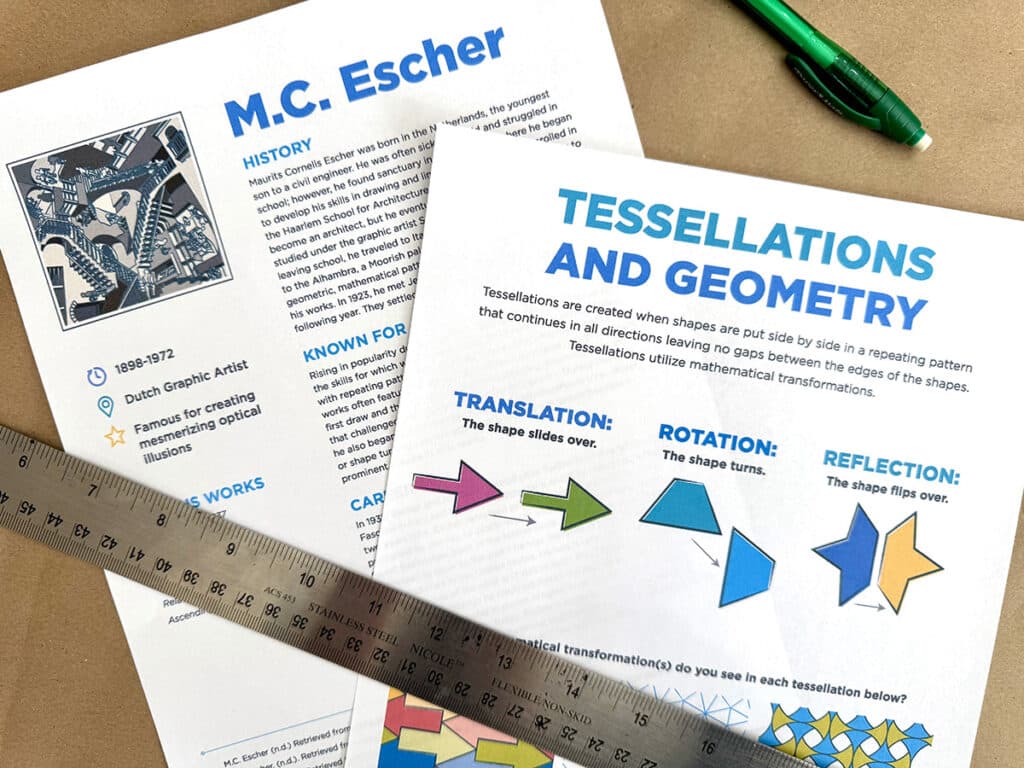
Tessellation printing introduces students to geometric tiling and spatial reasoning. Starting with a square, students modify the edges to create a repeatable shape, then transfer the design to foam or linoleum plates. Once carved, print the tile in rows to form a continuous, interlocking pattern. Use the Tessellations and Geometry Resource in FLEX Curriculum to easily illustrate this concept.
Celebrate Art
Intrigue students with the artwork of M.C. Escher and his impossible yet precise structures. His FLEX artist bio features an illustrated artwork, basic facts and famous works, and a brief history.
Celebrate Math
This activity highlights translation, rotation, and angle relationships, while giving students a satisfying, pattern-based design challenge.
3. Fraction Print Editions
Printing editions is a simple way to teach fractions and ratios. Students create a carved image and print a set number of copies. As they work, they calculate progress using real-world math. For example, model the language by saying things like, “We’re on print 3/5, so we’re more than halfway done!”
Celebrate Art
Shift perceptions around mistakes and reshape them into fabulous, special edition artist prints! Try adding a bit of color to misprints and show students how to label and sign them.
Celebrate Math
This focus makes fractions, division, and percentages relevant through a task that’s already a part of the printmaking process.
4. Grid-Based Fabric Printing
Students print on fabric items like scarves or tote bags, using carefully measured, even increments to space out motifs. The result is a beautiful fashion piece with a hand-printed surface design. Begin by measuring the surface area and calculating equal intervals between prints. Then, plan the overall layout using rulers and a grid system.

Celebrate Art
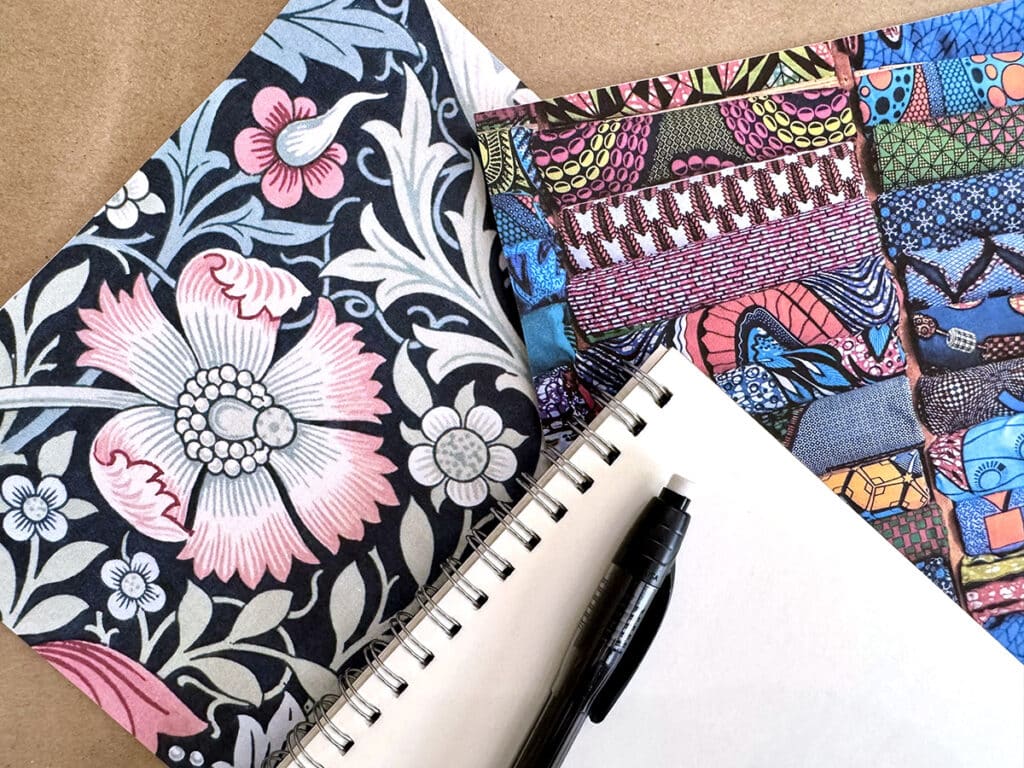
Share two very different styles of textile printing, such as William Morris and African Ankara fabrics. William Morris features elegant, intricate patterns. While his patterns are widely mass-produced today as fabric and wallpaper, he originally created them with a hand-blocking method in the late 1800s. African Ankara, or Dutch Wax Print fabrics, feature bold, colorful patterns with often symbolic shapes. These are also now machine-made, with hand-stamped roots in West Africa.
Celebrate Math
This process reinforces measurement, division, and area calculation. It shows students how math supports design accuracy and pattern consistency in real-world applications.
Be best friends with your math teacher, too!
While we know art teachers are smart, it’s helpful to bring in a math teacher in your planning, teaching, or both. Not only can it streamline your workload, but you can also make a new colleague friend! Plus, it will make you more intentional with how you integrate math concepts. A math teacher will probably know catchy and easy ways to explain them. They’ll also be able to tie in math standards (which will impress your administrator) and ensure everyone uses correct terminology.
At the beginning of the year, semester, or quarter, check in with your math teacher and see what’s on their curriculum map. See if there’s any overlap with yours and get a planning meeting on the calendar. Focus on one art concept and one math concept to keep it simple and clear. Emphasize both art and math terminology during instruction, studio time, and critiques. Finally, display student prints in both the art and math hallways!

Printmaking is a built-in bridge between creative and logical thinking. Elevating this connection in your classroom unlocks deeper engagement, hits administrative goals, and shows students how interconnected knowledge truly is. The best part is that printmaking and math are already best friends. Each step in the printing process is deeply tied to a mathematical skill or concept. Use the lesson resources and artist inspiration above and call out specific math terms to show that art sharpens logic and math enhances beauty.
Which math concepts easily fit into your next printmaking unit?
Share a favorite art and math lesson your students love every year!
To chat about printmaking and math with other art teachers, join us in The Art of Ed Community!
Magazine articles and podcasts are opinions of professional education contributors and do not necessarily represent the position of the Art of Education University (AOEU) or its academic offerings. Contributors use terms in the way they are most often talked about in the scope of their educational experiences.