
Remember that glorious feeling when a student makes a creative breakthrough? It’s that “aha!” moment, that electric spark of innovation, that we live for as art educators. While the art room is a comfortable space where students can explore their creativity freely, imagine the moments of genius born of a little productive tension. Just like a tightly wound spring, the tension is what gives the spring the power to launch forward!
Foster resilient problem-solvers by designing “What If” Challenges to encourage trial-and-error and curiosity.
Art thrives on the courage to embrace contradiction with curiosity.
Tension with conflict and stress can be a good source of friction that leads to growth. It’s the push and pull between two opposing ideas, plus the uncertainty that forces students to move beyond their “go-to” choices. This is where they build real critical thinking. Students learn to seek out multiple perspectives and justify their own decisions. This prompts them to think more deeply about their artwork and the world around them.
Realism vs. Abstraction
Consider the tension between realism and abstraction. While you could ask students to choose which style to work with, using it as a Challenge can get them to dig deeper. When students create a realistic self-portrait and an abstract self-portrait, you gently force them to grapple with questions of purpose, style, and audience.
In the realistic one, they’ll consider what happens when they render themselves exactly as they see themselves. They will also practice technical skill building. For the abstract one, they’ll have the opportunity to incorporate feelings and memories to capture their essence, priorities, and reputation.
Human vs. Natural
Another example is the tension between human-made and natural forms. Challenge students to create a sculpture that combines recycled electronics with natural materials like twigs, leaves, and stones. This forces them to navigate the visual contradiction between rigid, manufactured lines and organic, flowing shapes. They have to problem-solve how to join these materials in a way that is both visually compelling and structurally sound. The result is often a unique and thought-provoking piece that speaks to their relationship with technology and the environment.
Other Collaborative Contradictions
Pair students with other opposing concepts like light/dark, order/chaos, or urban/natural. Students will work together to find a way to express both in a single collaborative piece. This is a great class teambuilding challenge where they can practice communication, problem-solving, and considering new perspectives.
The power of “What if” Challenges is game-changing.
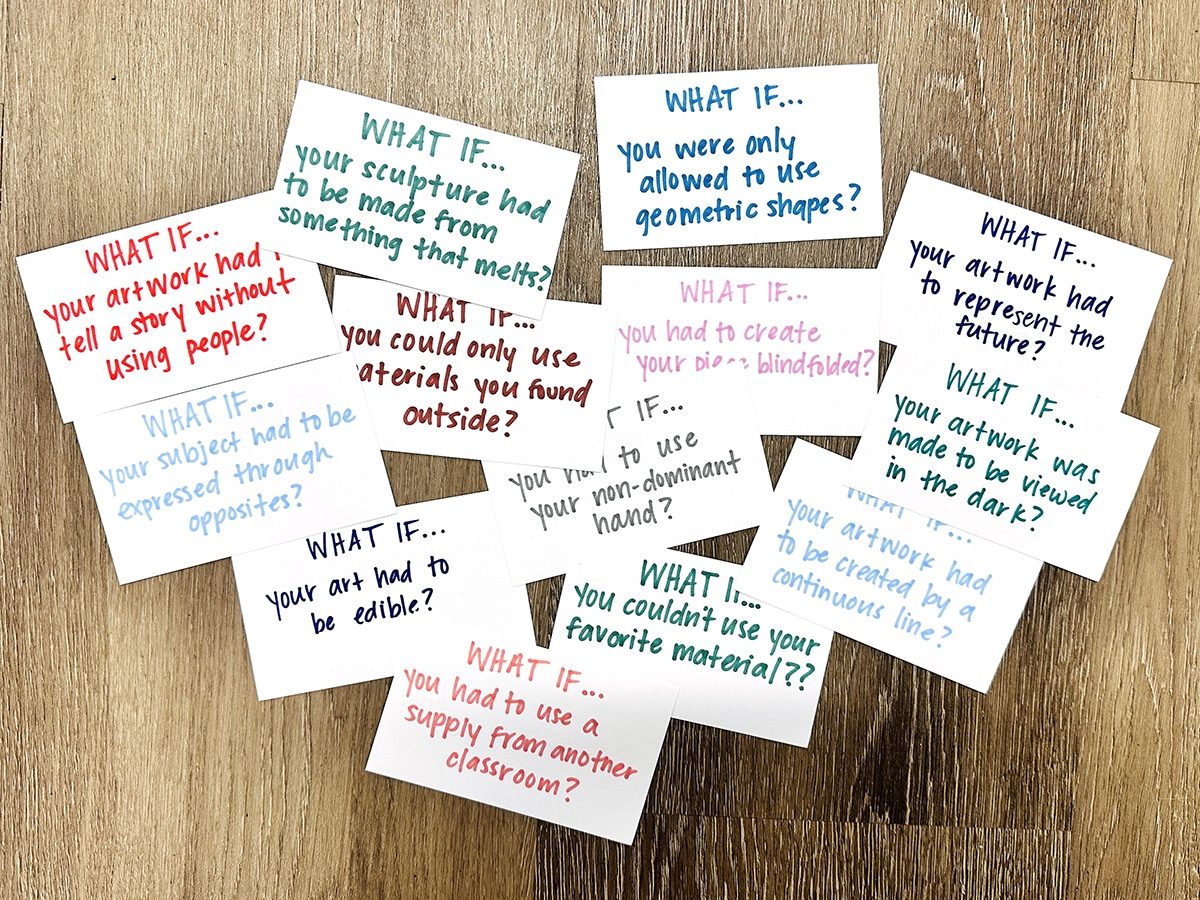
The most effective way to introduce productive tension is through “What If” Challenges. These structured prompts will disrupt students’ habits and push them toward genuine exploration. They keep students from settling into predictable answers and open the door to experimentation and play. These aren’t limitations to get frustrated over; rather, they’re invitations to a new adventure.
What if you couldn’t use your favorite material?
Challenge a student who always reaches for acrylic paint to create a piece using only charcoal or watercolor. This not only builds their skills with a new medium but also forces them to think differently about texture, layering, and line work. Ask a student who loves to sculpt with clay to create a form using wire. This initiates an exploration of negative space and how a form can be suggested rather than solid.
What if you expressed your subject through opposites?
This is a fantastic way to engage students’ imaginations. Ask them to create an artwork about a bustling city that feels quiet, or a piece about a sad memory that only uses happy, vibrant colors. This pushes them to move beyond a literal interpretation and think symbolically.
What if your artwork had to tell a story without using people?
Focus on narrative and hone their ability to communicate complex ideas through composition and form. A still life with a crumpled map, a worn book, and a half-empty teacup can tell the story of a long journey together. A landscape with a jagged, looming mountain peak can suggest fear and uncertainty as someone faces a new venture.
“What If” Wall
Create a communal space in your classroom where you or your students can post evolving “What If” questions. Pull from it for inspiration or turn questions into a dedicated sketchbook assignment. This makes the concept of curiosity a tangible, ever-present, and interactive part of your studio space.
Trial-and-error is worth leaving room for.
We have all seen a student get discouraged when their first attempt doesn’t look perfect. That’s why it’s crucial to normalize failure as fuel for creativity. Remind your students that professional artists rarely land on the final version on their first attempt. The artistic process is full of iterations, messy experiments, and happy accidents. Students need permission to “get it wrong.” Our role as educators is to embed trial-and-error directly into our lessons so there is ample opportunity to turn mistakes into discoveries, reflect, and build resiliency.
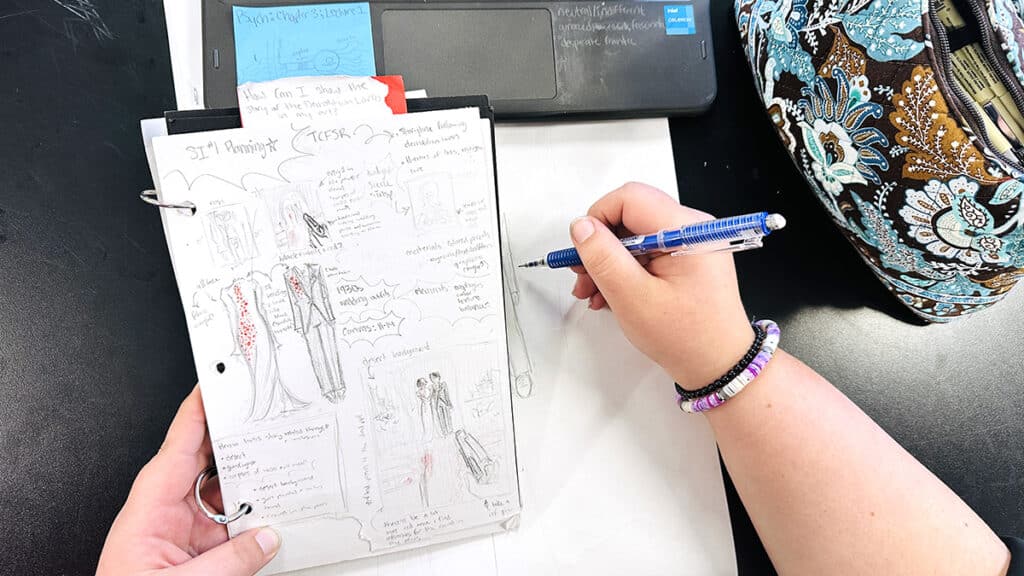
Quick Thumbnail Sketches
Before a student even touches their final paper, have them do a series of low-stakes studio warm-ups. Give them five minutes to create five different compositional ideas. The goal isn’t a masterpiece; it’s to get a variety of ideas down on paper. This helps them work through bad ideas quickly and focus on stronger ones to develop.
Grading Rubric
Make it clear that iteration is a valued part of the process by building revision into the rubric. Instead of just grading the final product, dedicate points to assess their process, too. For example, include a section for Exploration of Ideas or Material Experimentation. This shifts the focus from a single, high-pressure outcome to a continuous, rewarding journey.
SCAMPER Model
Introduce your students to a simple framework for innovation. SCAMPER stands for Substitute, Combine, Adapt, Modify, Put to Another Use, Eliminate, and Reverse. This is a powerful tool that walks students through the trial-and-error process when they get stuck and feel like giving up. You can also use the SCAMPER Model with a finished piece of art to generate fresh ideas and show revision.
For example, if a student has a creative block while working on their portrait, they can ask themselves:
- What if I substituted my surface?
- What if I combined two different perspectives?
- What if I adapted the emotional focus?
- What if I modified the color palette to be only analogous colors?
- What if I repurposed a material and put it to another use?
- What if I eliminated a distraction in my artwork?
- What if I reversed the viewpoint?

Reverse Critiques
Trial-and-error can often look like going backwards when you want to go forward. Embrace this mindset! Instead of focusing on what is working, have the class focus on what isn’t working and brainstorm solutions. A student may show a still life where the composition feels unbalanced. The class will generate a list of specific solutions to try, like, “What if you added something in the empty space to help tell a story?” or “What if you cropped out the empty space on the right?”
Sketchbooks are a way to document curiosity.
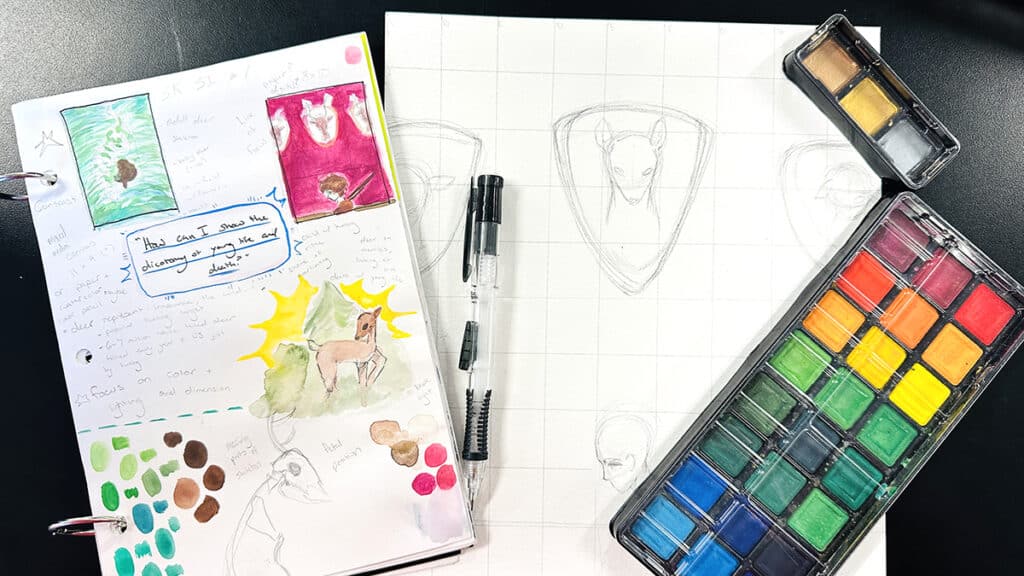
A student’s sketchbook shouldn’t just be a collection of polished drawings—it should also be a curiosity lab. It’s a place to track questions, document failed attempts, and celebrate unexpected discoveries. They can also use their sketchbooks to collect and collage images, jot down lines of poetry, or write short narratives about their plans. When you encourage students to document their thought process, they start to see their sketchbooks as evidence of their thinking and recognize their own growth. This nurtures more confident, self-aware artists!
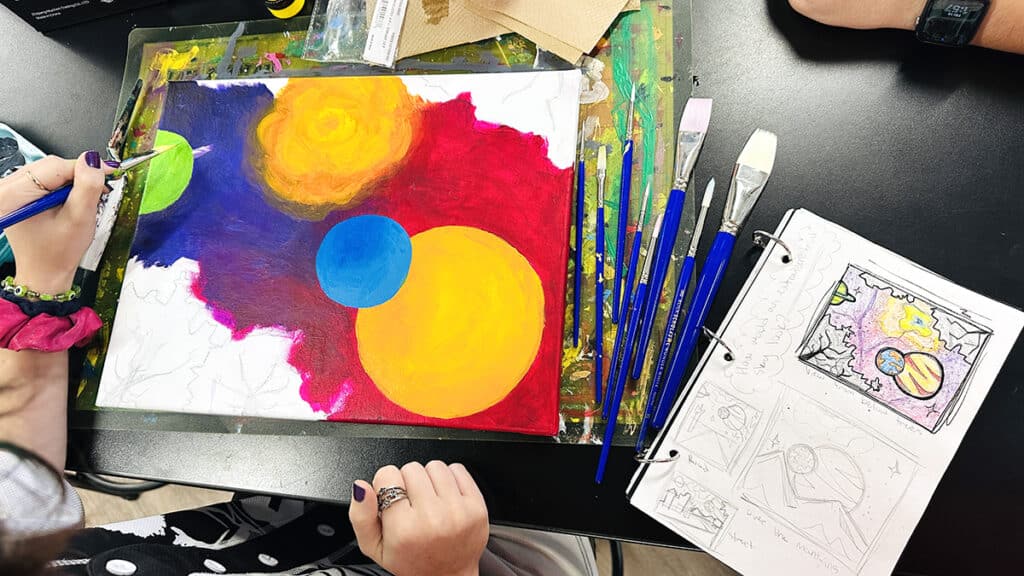
Here are three sketchbook prompts to ask:
- What question did you ask today?
This question encourages students to be observant and inquisitive. They may write, “What makes a shadow warm or cool?” or “How can I show motion with a static medium?” - What surprised you when you tried…?
This pushes students to reflect on the positive outcomes of their experiments. For example, you may read something like, “I was surprised that mixing purple and yellow pastel created a really rich dark brown; not a muddy mess like I expected.” - How did tension help you see different perspectives?
This is a prompt that helps students connect their process to the larger lesson. A student may say, “The tension of using a limited color palette made me focus more on the value and texture in my drawing, which made it stronger.”
Devil’s Advocate Sketching
Another strategy is to encourage curiosity about opposing viewpoints. On a sketchbook spread, have students draw or write their main idea on the left side. On the right side, they draw or write an alternative version that argues against the first idea. For instance, if the first idea is a harmonious landscape, the second may be a chaotic, jagged scene. This exercise forces them to see the strengths and weaknesses of both approaches. It makes their final work more well-rounded, both compositionally and conceptually.
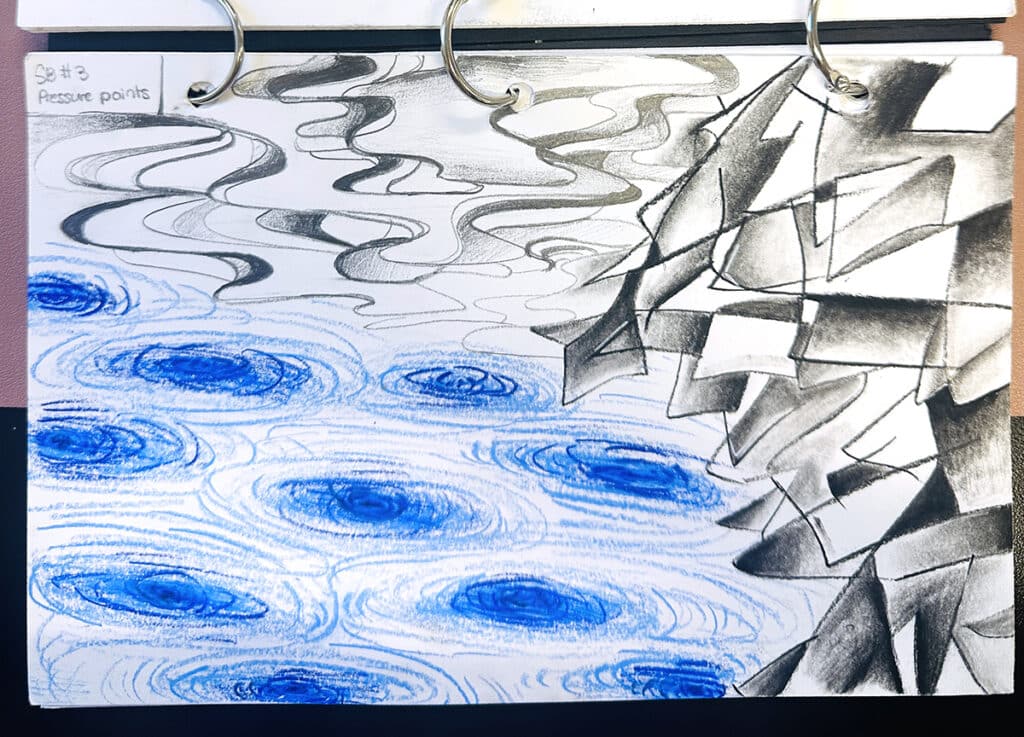
Ultimately, tension invites curiosity and can accelerate growth. The next time tension pops up in your art room, embrace it! You can even plan for it with guiding prompts, activities, and questions. Reinforce the mindset that mistakes and conflict are discoveries and not dead ends—especially for professional artists. Take hold of this vital ingredient for creativity with “What If” Challenges, trial-and-error, and sketchbook labs. In doing so, you’ll teach students to think critically, solve problems creatively, and face uncertainty with confidence!
Tell us an art room win! When have you seen tension lead to a breakthrough?
What are other “What If” Challenges you’d add to the list?
How do your students respond when faced with limitations or contradictions in their work?
To chat about curiosity challenges with other art teachers, join us in The Art of Ed Community!
Articles and podcasts are opinions of professional education contributors and do not necessarily represent the position of the Art of Education University (AOEU) or its academic offerings. Contributors use terms in the way they are most often talked about in the scope of their educational experiences.