


You are mid-registration, hovering over the “enroll” button for a course you’ve been meaning to take. The topic matches exactly what you need. The timing works. But the tuition cost gives you cold feet, so you close the tab.
Here’s what many art teachers don’t know: Your district may already have funds set aside to help you pay for that course. Many school districts across the country offer tuition funding for their employees. Your teacher contract almost always spells out the details, including how much your district will pay, who qualifies, and which expenses the benefit covers.
Use this practical guide to locate tuition funding language in your teacher contract to unlock funding and make your art teacher dreams come true!

Start with what’s already possible.
According to a survey of The Art of Education University (AOEU) alums, 85% reported earning more money after completing their graduate work. Graduate coursework and degree programs can increase your salary or move you into a higher salary lane on your district’s pay schedule. Plus, more than 40% of AOEU alums used some form of tuition funding from their district to help pay for graduate studies. That’s a significant number of art teachers who pursued additional education because their districts supported them, at least in part. So, how can you leverage what’s already on the table?

Find tuition funding in your contract.
Your contract might not be a page-turner, but it offers incredibly valuable information. While it’s a good idea to read your contract in full, you can quickly find what you need with some shortcuts. If you have a digital copy, use Ctrl+F (PC) or Cmd+F (Mac) to search for specific terms. If you only have a paper copy, check the table of contents for sections labeled “Benefits,” “Compensation,” or “Professional Development.” Then flip to those sections and scan for the terms below.
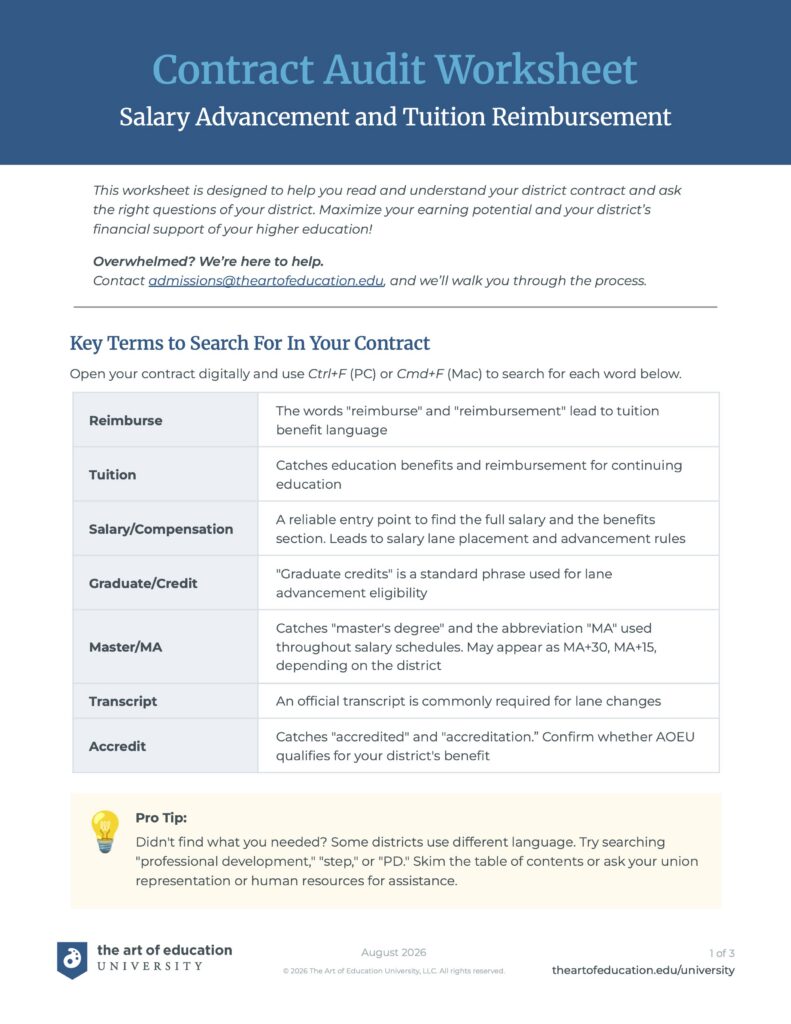
Search for these key terms:
- Reimburse: This term captures both “reimburse” and “reimbursement” and can lead you directly to the tuition benefit language.
- Tuition: This pulls up any language about continuing education benefits.
- Salary or Compensation: These terms can point you to salary lane placement and advancement rules.
- Graduate or Credit: Districts commonly use the phrase “graduate credits” when they explain lane advancement eligibility.
- Master’s or MA: Look for these terms in salary schedule language, such as MA+15 or MA+30.
- Transcript: Districts typically ask employees to submit official transcripts when they request a lane change.
- Accredit: This term helps you confirm whether your institution qualifies under your district’s rules.
Pro Tip:
If you’re not finding anything under these terms, try “Professional Development,” “Step,” or “PD.” Some districts use different language. And if you’re still stuck, reach out to your union representative or human resources department.

Read the fine print like an art teacher.
Art teachers solve problems naturally. You read a room, adjust on the fly, and work with what you have. Now, apply that same energy to your contract! Once you find the relevant section in your contract, look for specific details. We created a Contract Audit Worksheet to help you capture everything in one place.
Hunt for the big picture by asking yourself these three questions:
- Does earning a master’s degree (or additional credits) move me into a higher salary lane?
- How much could my salary increase, and how many credits would I need to reach that point?
- Will my district cover part (or all) of the cost?
Consider the nitty-gritty details by asking yourself these questions:
- How much will my district reimburse per credit?
- Does my district cap the number of credits or total dollars I can claim each year?
- Is pre-approval required before I enroll?
- Does my coursework need to connect to my teaching assignment or a degree program?
- Does my institution need to be regionally accredited?
- What grade must I earn to qualify?
- Which documents must I submit, and when must I submit them?

Make a plan (and make it exciting!)
Once you understand your district’s rules, you can build a real strategy. If you need 15 credits to move to the next lane, map out which courses you’ll take over the next 12 to 18 months. If your district reimburses up to three credits per semester, calculate how long you’ll need to reach your goal. If your district caps annual reimbursement, plan how to maximize that benefit. Any plan that helps you reach your end goal is a smart one! The key is knowing your district’s rules so you can choose courses that count.
Here’s the part that doesn’t get said enough: the coursework itself can be genuinely energizing. These courses will change how you teach and how you think about your work. Imagine taking a watercolor course on someone else’s dime and bringing a fresh creative practice back to your classroom. Or complete a ceramics course that gives you the confidence to finally launch a wheel-throwing unit. AOEU offers graduate-level courses built specifically for art teachers, covering everything from studio media to curriculum design to classroom management.
For teachers seeking a focused, structured path, AOEU’s Studio Art Certificates are worth a closer look. Each certificate includes 18 graduate-level credits. You can complete the program in as little as six months or take up to two years, entirely online. Choose your focus in 2D or 3D media and get back to creating art with intention. Many districts count 18 credits toward a lane change, and each course can help you deepen your studio practice.
For those looking to go further, a master’s degree from AOEU typically takes 18 to 24 months. You can complete the program 100% online, and the degree can unlock salary increases that compound over the course of your career. Becoming a degree student can sound overwhelming, but there are plenty of sustainable ways to integrate your coursework into your everyday life.

What if tuition funding isn’t in your contract?
You did the work—you searched the terms, read the sections, and asked all the right questions. Then you got a disappointing answer: There’s no tuition funding. That stings, and it’s okay to feel that way. But you can keep the conversation going. You still have options, even if they look different from what you hoped.
Take these next steps:
- Ask about professional development funds.
Some districts let employees use professional development dollars for graduate coursework, even when they don’t offer a formal tuition funding program. It’s worth a direct conversation with your principal or HR department. - Look into school-sponsored scholarships.
Some districts or parent-teacher organizations have scholarship programs that aren’t widely publicized. - Get involved in the next bargaining cycle.
If you belong to a union, join the collective bargaining team so you have a seat at the table when it’s time to write the next contract. Art teachers are often underrepresented in these conversations, and your perspective matters. You may even help your team add a tuition benefit to the next contract!
Your teacher contract is a document, not a barrier. Treat it like a resource, read it with curiosity, and use what you find. Whether your district covers three credits a year or a full master’s degree, knowing what you’re entitled to is the first step of your continuing education journey. By asking questions and taking action, you can make your professional goals affordable and your art teacher dreams achievable.
Are you ready to take the next step? AOEU’s Enrollment Team can help you understand how graduate coursework translates to real dollars on your salary schedule. Reach out today.
What course would you take first if your district were helping to foot the bill?
To chat about tuition reimbursement and graduate planning with other art teachers, join us in The Art of Ed Community!
Magazine articles and podcasts are opinions of professional education contributors and do not necessarily represent the position of the Art of Education University (AOEU) or its academic offerings. Contributors use terms in the way they are most often talked about in the scope of their educational experiences.