Middle school students experience rapid change during sixth through eighth grade, from mood swings and growth spurts to increased tiredness. No wonder so many of your students get stuck in a creative slump! Ideation is one of the most important artistic phases because it gives students time to be curious, embrace weird ideas, stay engaged with peers, and process thoughts creatively. Adding the four brainstorming exercises below will help grease their creative wheels and move from blank stares to pages filled with scribbles, thumbnail sketches, and planning notes.
Tune in and discover four strategies to get middle school minds flowing.
Brainstorming helps middle school students understand content, skills, and techniques as they prepare to bring an idea to life. The “perfect” idea doesn’t usually happen instantly, so students will need coaxing to generate options. Using strategic brainstorming in your lesson cycle helps students become free creative thinkers, fully express their ideas, and explore opportunities.

1. Ideation Storm
Ideation Storm is a five-phase brainstorming process that generates a variety of ideas. It reduces groupthink, where everyone focuses on only one solution. It provides plenty of guided talking time, meeting middle schoolers’ need to chat nonstop. This activity also allows introverted students time to prepare alone before sharing.
Follow these steps to stir up ideas:
- Daydream
Write out as many ideas as possible individually in two minutes without crossing out or erasing. - Stormcloud
Pair with a shoulder partner and share ideas, adding new ones to the list. - Rain
Talk as a group and share ideas, adding new ones to the list. - Thunder
Record ideas on the board. Students can shout out ideas to create a “thunderstorm” or raise their hands to create a “controlled storm.” When the “eye of the storm” hits and the room goes quiet, give the tables an extra thirty seconds to come up with one or two more ideas. - Lightning
Analyze final lists individually, searching for a “lightning bolt” of inspiration.

2. Creative Campaign Map
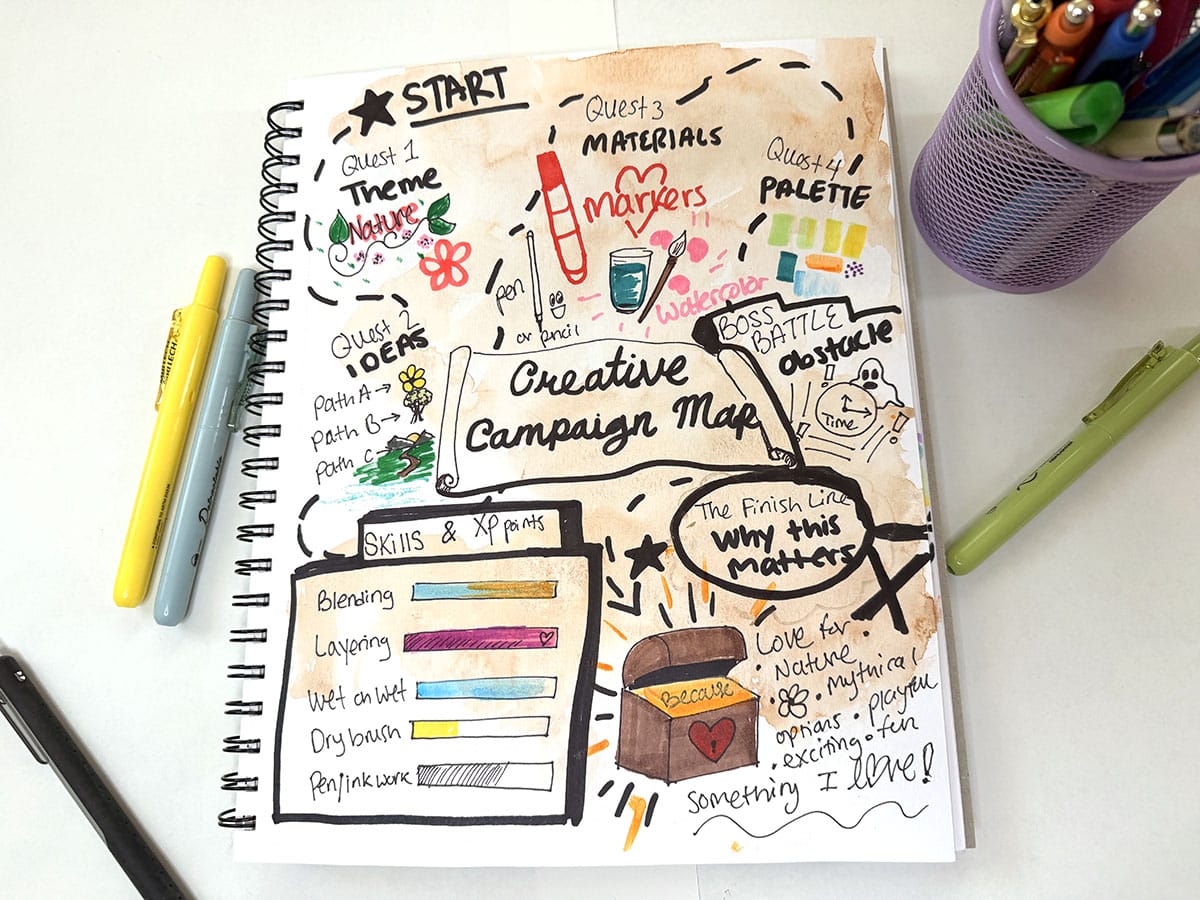
Mind maps are a powerful tool for organizing thoughts and ideas, especially when combined with sketchnotes. Bring this pairing to your students with a creative campaign twist to unlock a dynamic way to visualize concepts. For more ways to harness sketchnotes in your art room, watch the professional development PRO Learning videos in the Pack, Implementing Sketchnotes.
Grab your students’ sketchbooks and lay out highlighters, sticky notes, pens, markers, and other markmaking tools. In the center of a blank page, write the campaign title or theme and draw an eye-catching shape around it. Theme-focused art increases deeper thinking and cohesion across a series of projects. Add side quests with the ideas below to prompt investigation.
Incorporate these gamified elements as branches of their mind map:
- Quest 1
Sketch quick initial ideas based on the upcoming campaign or theme. - Quest 2
Reflect on the strongest quest and let students’ imaginations run wild! Explore all of the ideas that come to mind, whether through writing or sketching. If they have multiple concepts, add additional paths to explore. - Quest 3
Pre-plan material options so students don’t have decision fatigue. Display specific supplies and mediums that students can practice with. - Quest 4
Test out color schemes that reflect their quest. Try using the Coolors generator to randomize color schemes or explore Coolors Trending Color Palettes. - Skills and XP
Make a quick list of the art skills and techniques students will need to execute their campaign. Then, sketch a progress bar for them to self-rate their experience level. - Boss Battle
Tackle obstacles and roadblocks as they surface and encourage risk-taking. Record epic details! - The Finish Line
Uncover deeper treasures in the campaign by noting how each idea or detail personally connects to them.
3. Three-Three-Three
This is a quick brainstorming activity that draws on individuality and group metacognition, without asking too much of your shy students. The process is straightforward and takes about ten minutes, making it efficient for the middle school art room and short attention spans. Use a digital timer or chime to set the pace and keep students moving fluidly through the three steps.
Note these three steps:
- 3 Minutes for Self
Write down every “stream of consciousness” idea students can think of for their project—without any editing! Encourage students to draw from their imagination, a word wall, an inspiration wall in your classroom, or items throughout the room. Focus on quantity. - 3 Minutes for Pairs
Partner with a peer at their table for limited movement. The first person shares all their ideas for one minute, and the second person shares for the next minute. In the last minute, both students go back and forth on which idea is most important or exciting to them. - 3 Minutes for Reflection
Review and reflect alone. Students remove concepts they don’t like and add ones they heard from their partner. Circle and expand on three favorite ideas to determine the next project.

4. Music to Concepts
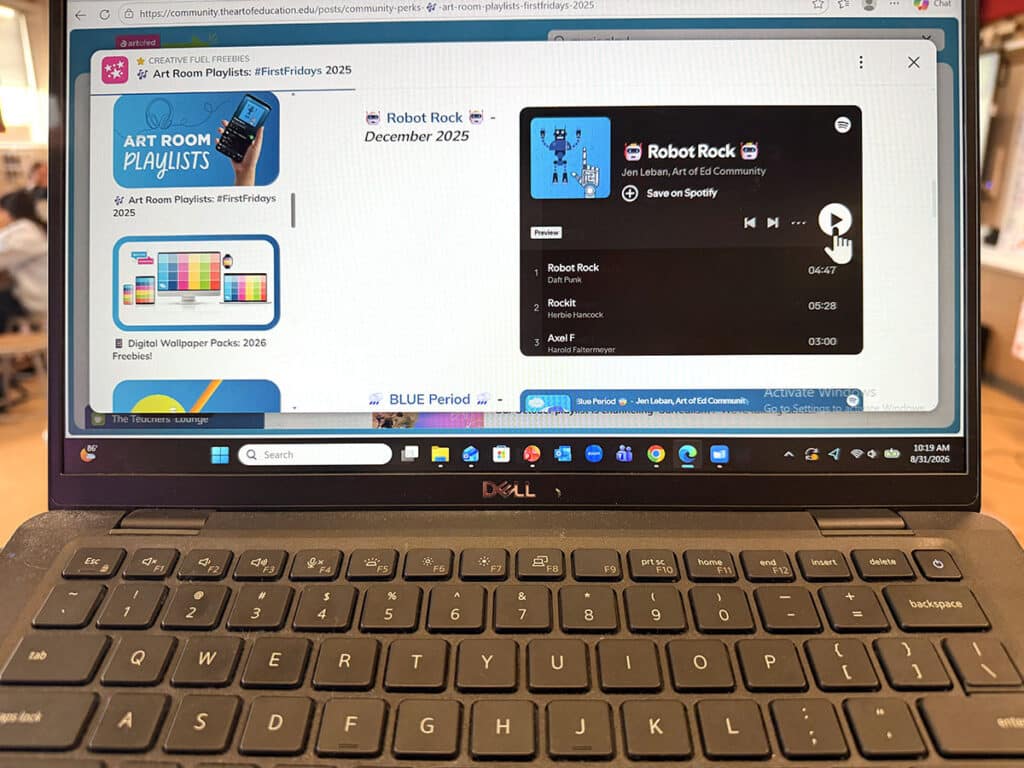
Pop culture references can enhance students’ learning by fostering curiosity, as they connect familiar concepts with new ideas. Draw on the power of music to not only get students thinking, but also strengthen relationships as you learn more about your students’ lives and preferences. Get started with classroom-ready playlists from The Art of Ed Community, such as Robot Rock and Good Vibes. These playlists are pre-approved and feature school-appropriate songs and fun, artsy themes!
Try these two musical ideas:
- Concepts to Tunes
Present a theme to your students and have them choose a song that “matches” the vibe. For example, if the theme is Joy, students can choose songs such as Happy by Pharrell Williams or Walking on Sunshine by Katrina and the Waves. Encourage students to match as many songs as possible to the theme and explain why. - Tunes to Concepts
Flip the method by playing a 30-second song intro so students can develop themes that match the music. Students may be inspired by the song title, lyrics, or beat, but prompt them to dig deeper and find meaning in the words or sounds. Print a feelings wheel to guide this activity.
Brainstorming activities are great for activating creative thinking, problem-solving, and overcoming roadblocks in the art classroom. Use creative exercises to guide students through ideation, encourage big, small, and weird ideas, and keep students engaged in the artmaking process. The next time you start a unit or are in the early stages of planning, try an ideation storm, a visual journal mind map, the three-three-three method, or music to get your students thinking outside of the box.
Which tactic are you most excited about implementing in your next art lesson?
In what ways do you incorporate brainstorming throughout all stages of artmaking?
To chat about middle school ideation with other art teachers, join us in The Art of Ed Community!
Articles and podcasts are opinions of professional education contributors and do not necessarily represent the position of the Art of Education University (AOEU) or its academic offerings. Contributors use terms in the way they are most often talked about in the scope of their educational experiences.