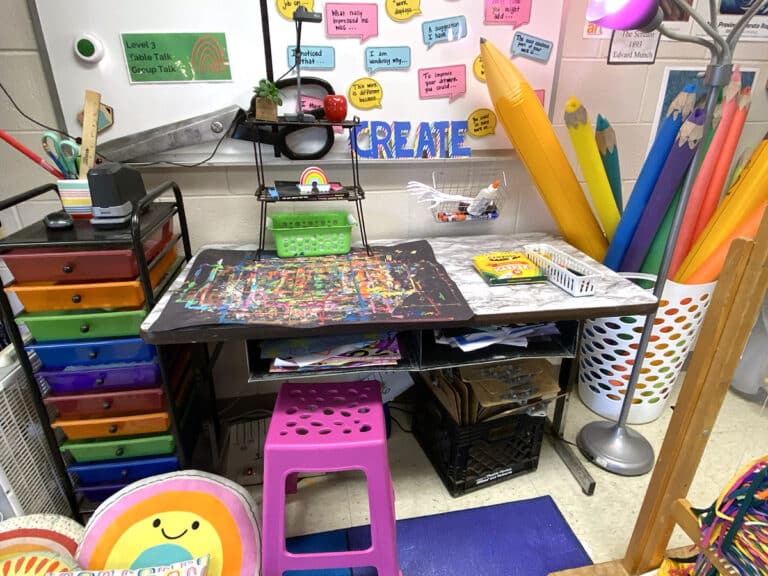
You placed your supply order months ago. Now, the tempera is dried out, some of the good brushes have gone missing, and the construction paper drawer only has the colors everyone avoids. This is familiar, especially when you factor in the $3 average per-student art budget, minimal planning time, and uneven administrative support shown in the last State of Art Education Survey. However, budget lines capture only one type of resource—every single art room holds additional value: the questions students bring, the results nobody planned for, and the quiet evidence of growth between projects.
Notice what is already growing in your art room and recognize three forms of value that may be easy to overlook.
1. Harvest student curiosity.
The most immediate and endless source of new ideas is sitting in your classroom now. A student fidgeting with a scrap of foam packaging or doodling on their hand is curious, not bored or distracted! Given the room to continue, that kind of tinkering can turn into research, trial and error, or an unplanned detour into art history.
Relationships will do most of the work for you. The longer you know your students, the more you recognize the many resources they bring to class, from their cultural and neighborhood traditions to their unique hobbies. By showing interest in your students, you invite them to bring their backgrounds and passions into their projects.
If curiosity feels harder to spot some weeks than others, that’s normal. Ask questions out loud about your own teaching, your curriculum, or the field itself, and students will see questioning as something adults do too. The Center for the Advancement of Art Education (CAAE), AOE’s research and innovation hub that produces materials that strengthen the art education profession, exists because someone asked a good question about art education and refused to let it go. Your classroom can work the same way.
Try these three quick ideas to encourage and foster curiosity:
- Keep an “I Wonder” collection.
Record students’ questions on a board as they talk to you. Then, revisit the collection regularly and choose one to investigate together. - Curate from student interests.
Periodically ask students what they are curious about outside of school, and use their answers to shape a materials challenge, a future demonstration, or an art history mini-lesson. - Try a “What We Bring” prompt.
Ask students to identify something (an object, image, place, etc.) that is meaningful to their family and community. Document it through sketches, photos, or written notes, and use that documentation to identify colors, patterns, and materials that represent the tradition or memory.
2. Harvest unexpected results.
Artmaking rarely goes exactly as planned. Rather than treating this as a problem to fix, try to help students see “mistakes” as an opportunity for creative problem-solving. Share with your students the story of The Bride Stripped Bare by Her Bachelors, Even (The Large Glass) by Marcel Duchamp: the piece shattered during transport, but rather than restoring it, Duchamp looked at the cracks running through the panels and decided they belonged there.
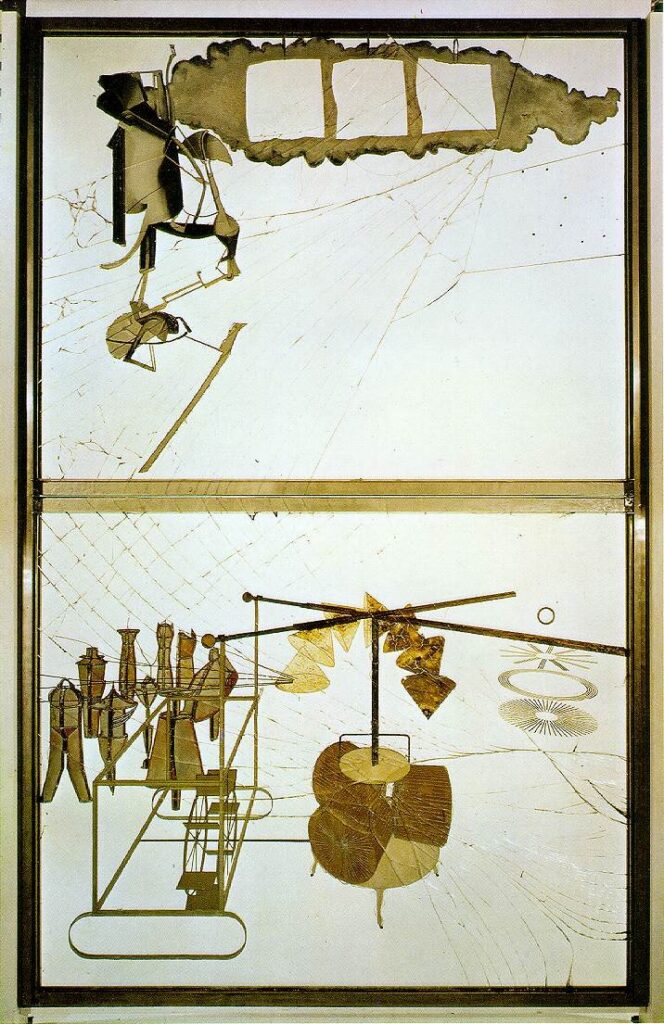
This type of willingness to pivot will not emerge immediately, as few classroom accidents will be met with Duchamp’s level of philosophical acceptance. But with some modeling, students will learn how to adapt. So the next time the glaze runs, the collage papers separate, or a sculpture collapses under its own weight, help the student resist the urge to treat it as an error.
Ask your students these four questions the next time they face a “mistake”:
- What happened?
Recognize that the student may have an immediate emotional response, and help them move past it by asking them to describe the results in plain terms, without judgment. What did the material actually do? - What did you learn about the material?
Embrace the “teachable moment” because every surprise will reveal how certain materials behave under pressure, moisture, heat, or time. - What could this become now?
Invite students to consider what their unexpected result now makes possible, rather than returning to the original plan. - Would you make the same choice again?
Encourage students to reflect on what they’ve learned and apply it in the next project.
3. Harvest evidence of growth.
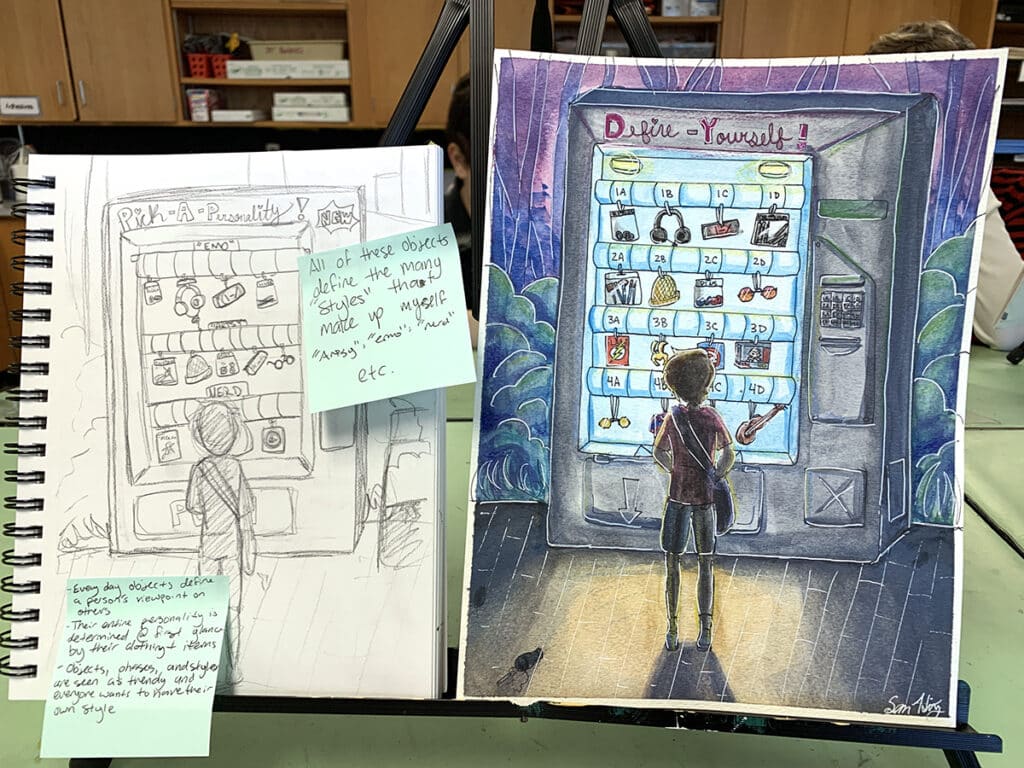
As you know, the finished artwork only tells part of the story of the art room. Sketches, artist statements, and even students’ offhand comments about why they scrapped their original idea all carry evidence of learning that the final work can’t show. Making this evidence visible requires intention, but it should not require excessive time and effort.
Capture a moment of student thinking that would otherwise disappear with these four suggestions:
- Photograph work in progress.
Make sure you do not capture any personal identifying details, and use the images to document student revisions and experimentation over time. - Pair artifacts with student voice.
Record student comments explaining the thinking behind the finished product. - Build a process portfolio.
Save one sketch or reflection from each unit, then compare the earlier and later examples at the end of the semester or year to see how skills developed. - Keep a folder of evidence.
Pull two or three pieces and pair them with the learning targets or standards that they demonstrate. The CAAE’s new Advocacy Field Guide includes sample stakeholder messaging designed for exactly this type of conversation.

Make every week a harvest season.
You don’t have to do a complete overhaul of your curriculum to harvest curiosity, unexpected results, and growth, but all of them require building a habit. Start small. At the end of each week, take five minutes to record just one thing: a student question worth revisiting, an unexpected result from artmaking, or a piece of evidence worth saving.
Over time, those five minutes have a compounding effect, resulting in something bigger than a personal archive. You will have a bank of ideas for next semester’s projects, as well as a running record pairing student voice with standards and learning targets—clear proof of the learning that happens in art class. It also serves as evidence you can present to an administrator, using the CAAE’s always-evolving advocacy resources. These are more than ordinary classroom moments; they’re the abundant harvest you need when it is time to advocate for your program.
What is already growing in abundance in your art room?
Check out the free advocacy resources in the Center for the Advancement of Art Education (CAAE).
To chat about resourcefulness with other art teachers, join us in The Art of Ed Community!
Articles and podcasts are opinions of professional education contributors and do not necessarily represent the position of the Art of Education University (AOEU) or its academic offerings. Contributors use terms in the way they are most often talked about in the scope of their educational experiences.