
Note: This article was written in collaboration with Lindsey McGinnis.
In today’s schools, art teachers face unprecedented changes, including behavioral concerns, shortened attention spans, and constant screen time, all of which are just the tip of the iceberg. While we as art teachers know visual art matters, it’s tricky to articulate clearly how art helps address these problems in schools right now. A strong art education program increases attention, grit, and empathy. It nurtures strong creative leaders and thinkers, and prepares students for life beyond the art room.
Clearly and confidently communicate the value of the visual arts in our rapidly changing technological world with these five key areas.
For research-backed and practical advocacy strategies, explore the wealth of resources available through the Center for the Advancement of Art Education (CAAE). This information will equip you to make your work more visible, relevant, funded, and deeply appreciated by administrators, colleagues, parents, and students.
1. Art encourages hands-on engagement in a screen-saturated world.
Modern students live in a digital landscape that rewards speed and distraction, a topic fleshed out in The Anxious Generation: How the Great Rewiring of Childhood is Causing an Epidemic of Mental Illness by Jonathan Haidt. Students are encouraged to consume in order to keep up, which can be very exhausting, especially for developing minds and identities. The art room gives students a pause button from the virtual chaos and celebrates creation over consumption through the development of attention, patience, and focused observation.
For more ways to help students mute the digital noise, check out these resources:
- Cell Phones in the Art Room: When They Help—and Why Tech-Free Time Matters, Too
- 13 Technology-Free Ways to Engage in the Art Room
- 3 Subtly Effective Ways to Manage Screen Time in the Art Room
- How to Use Neurographic Art to Encourage a Calm and Focused Mind

Communicate the value of the visual arts to others:
- Invite administrators and parents to make hands-on art alongside students during special Open Studio Days.
- Collect student feedback and share impactful quotes about enjoying screen-free time.
- Document pre- and post-test artworks to show how students’ attention, patience, and craftsmanship developed over time.
2. Art engages introverted students.
We all know the “artsy kid;” they’re quietly doodling in the corner of your art room, perhaps labeled as “shy” or “anti-social.” Sometimes, our advanced courses and extracurricular activities are comprised of several of these personalities. How do we harness the power of the introverted student to make art visible, especially when this can account for up to half of our class?
First, it helps to expand our views on the introverted-extroverted continuum. According to Susan Cain, author of Quiet, introverted individuals don’t necessarily equate with shy or quiet. While they certainly can be, introverted students crave less stimulation and prefer to work more slowly and deliberately. Contrary to public opinion, many introverts really enjoy deep discussions, as long as they are meaningful and in smaller groups.
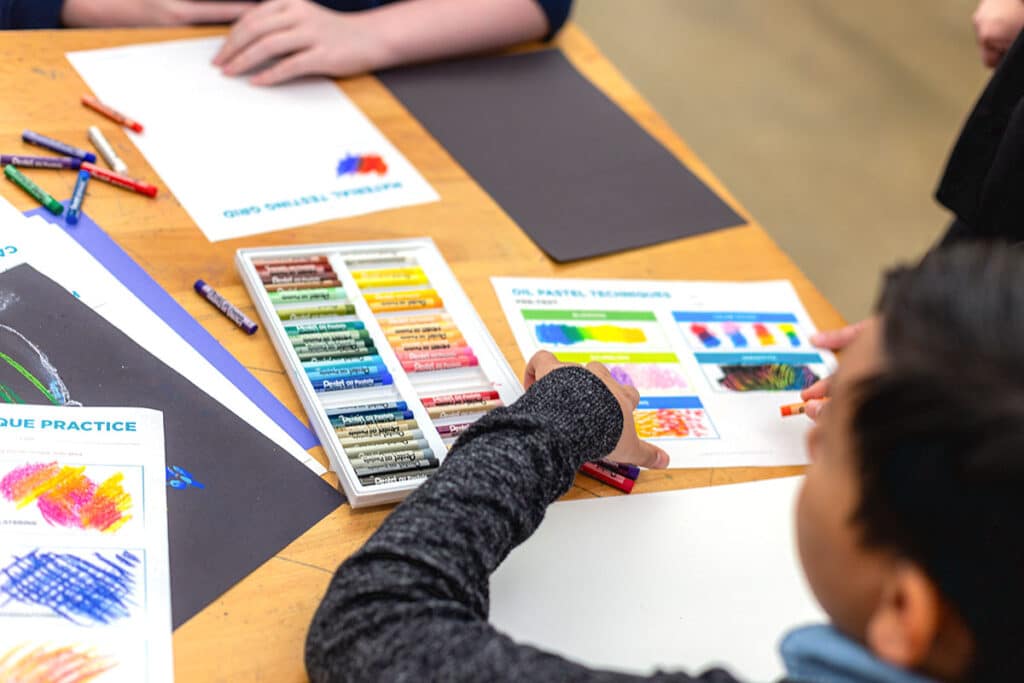
This conflicts with the ideal student in our society. Teachers often value the extroverted learner: one who is charming, chatty, loves group work, and frequently raises their hand to participate. Many introverted students thrive in art class because there’s independent studio time to process thoughts and ideas first. Art gives students a voice to share a powerful message without requiring them to speak. The curriculum and standards also create space for meaningful reflection in critiques and artist statements, which is thrilling for many introverts.
Communicate the value of the visual arts to others:
- Highlight introverted leadership roles in your art room and the introverted students who excel in them.
- Emphasize that quiet cognition is still rigorous by sharing process spreads and experimentation pages.
3. Art supports positive behaviors.
We’ve all seen student behaviors ramp up over the past few years. The increase in screen time fuels comparison, desensitization to news, and the spread of false information. No wonder our students’ anxiety is on the rise!
The solution? Art class! When students enroll in and engage with art classes, schools show lower suspension rates and fewer disciplinary incidents. The art room is a creative escape from core classes, where students can focus on building relationships, developing time management skills, cultivating patience, and fostering resiliency. All of these positive behaviors support independent students.
Gain tips to conquer challenging behaviors in the art room with Draw the Line. Kyle Wood and Liz Brent tackle the real classroom management challenges art teachers face every day. They address wild and tricky behaviors and share heartwarming stories to keep your art room calm, both in the heat of the moment and through proactive systems.
Communicate the value of the visual arts to others:
- Use clear research and specific phrasing in conversations, such as “reduced discipline issues” when building a case for arts funding.
- Collect your own data, like attendance records, student reflections, behavioral improvement plans, and work samples.
- Invite school counselors and showcase how restorative circles and critiques overlap in the art room.
4. Art is the perfect place to prepare students for life.
In his book, The Coddling of the American Mind, Greg Lukianoff and Jonathan Haidt research and analyze why students and teachers are experiencing division and are afraid to speak honestly. You may have seen this trickle down to your art room: students shutting down with constructive criticism during a critique, or students becoming fatigued after a short period of artmaking.
Life is full of failure and the unexpected—just like art! The art room is the perfect place to hone discussion skills and critical thinking through challenging topics. Skill-building exercises during studio time are a fun way to escape the tedious and rigid assignments from other classes, increase discipline, and grow confidence!
Bookmark these resources to intentionally connect life skills to art skills:
- How to Help Your Students Learn to Talk to Each Other Again
- Failure-Friendly Art Rooms: How to Redefine Mistakes as Learning Opportunities
- 3 Strategies to Help Students Find Their Voice in the Art Room
- 12 Essential Understandings to Improve Your Art Students’ Research Habits
Communicate the value of the visual arts to others:
- Explicitly connect and call out specific art skills to life and career readiness skills.
- Align art projects and outcomes with district initiatives.
5. Art fosters empathy.
Doomscrolling, binge-watching, and multiscreening—all of these terms are now the numbing norm. In a world where screens are everywhere you turn, art is the one place where people, process, and product are more important than profiles. While art can integrate AI and technology, art is still widely about the human touch and human emotions, making it the oldest universal language.
Students go through many developmental changes from kindergarten all the way up to senior graduation. Art allows them a judgment-free zone to process their experiences and gives them a healthy outlet for expression. Examining art history is a way for students to see how people captured and conveyed emotions in ways that transcend time and cultures. All of these things boost emotional intelligence in ways that consuming content cannot.

Communicate the value of the visual arts to others:
- Curate prompts and displays around deeper concepts to showcase your students’ emotional intelligence.
- Include artist statements and student-written narratives in your exhibitions.
- Partner with community organizations to create work that responds to real human experiences.
Visual art is not a luxury or just an extra elective—it’s an essential space where students learn to slow down, reflect, empathize, and persist in a rapidly changing technological world. When we research, collect evidence, tell stories, and communicate with intention, we have the power to turn everyday studio moments into advocacy tools. When stakeholders understand the impact of the visual arts, they become partners in sustaining and growing our students’ creativity.
What’s one way you’ve made art visible in your school or community?
To chat about the value of art education in today’s changing world with other art teachers, join us in The Art of Ed Community!
Magazine articles and podcasts are opinions of professional education contributors and do not necessarily represent the position of the Art of Education University (AOEU) or its academic offerings. Contributors use terms in the way they are most often talked about in the scope of their educational experiences.