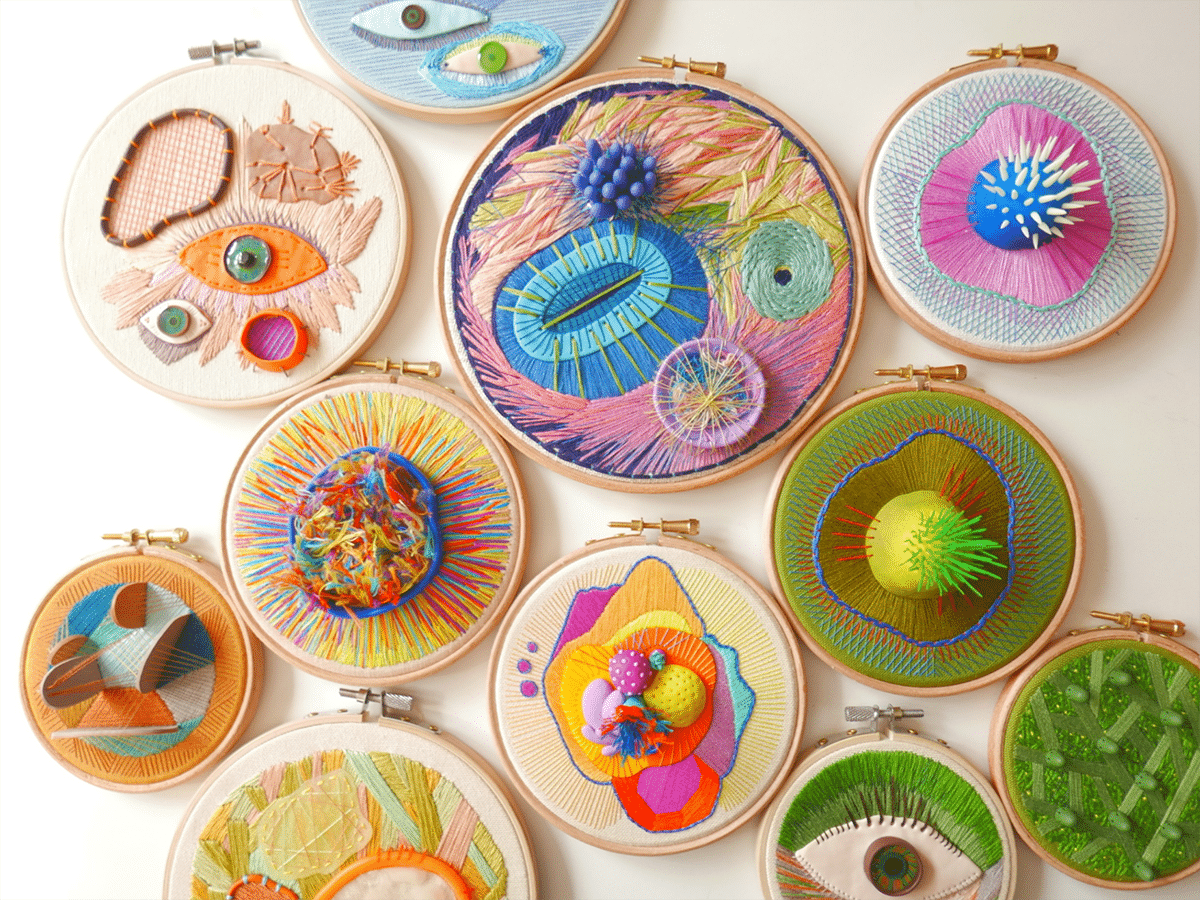
If you’ve fallen in love with air-dry clay, you know it’s fun, manageable, and versatile. While it can be a substitute for traditional kiln-fired clay, it can also be a unique medium in its own right. It’s time to push this accessible material even further! Explore inventive projects that bring together conceptual thinking, storytelling, unexpected material combinations, and art history—all with air-dry clay.
Push air-dry clay beyond traditional skill-building with these unexpected combinations, surfaces, illusions, and installations.
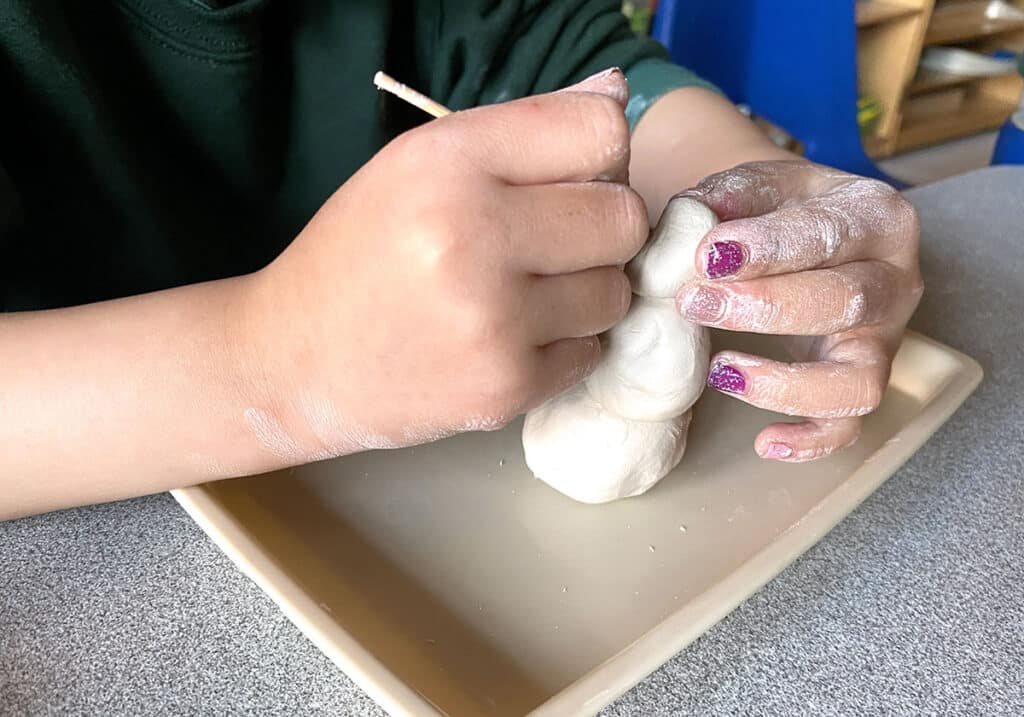
1. Sew and embroider through clay.
Pair air-dry clay with embroidery and fiber to explore the contrast between hard and soft and rigid and flexible. Students can begin by rolling or pressing relatively thin (but still sturdy) clay forms. Pierce intentional holes while the clay is still wet and workable. Once the pieces are completely dry, sew through the punched openings with embroidery floss, yarn, thin cord, ribbon, or even wire.
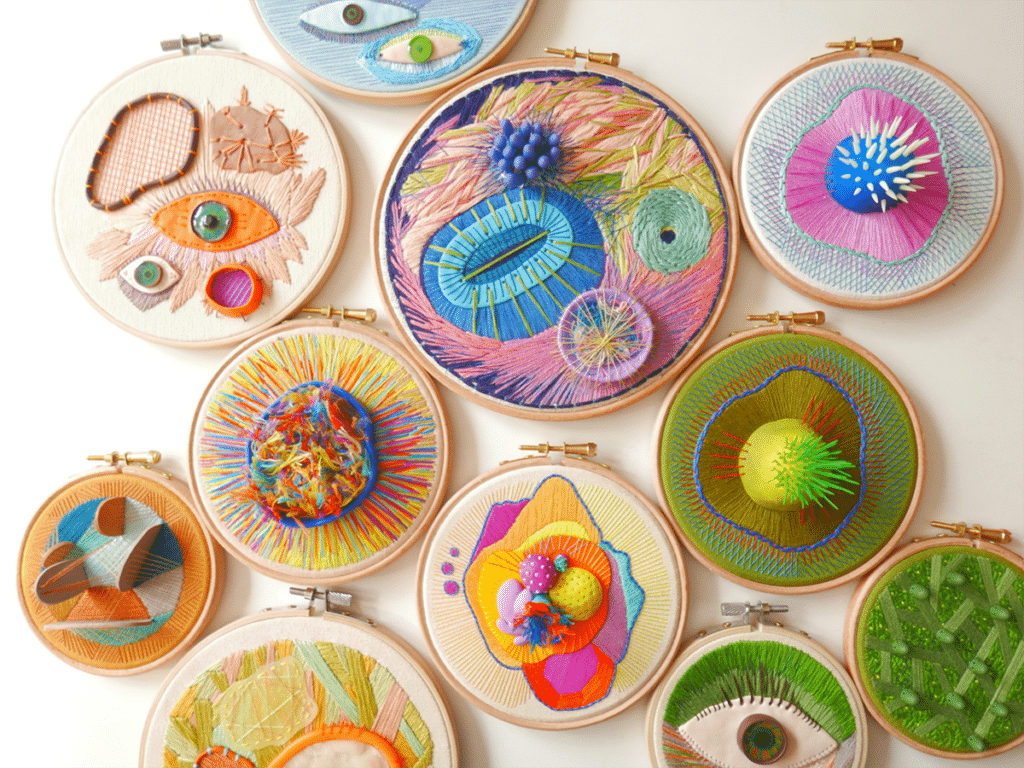
Rather than treating the fiber as an embellishment added at the end, challenge students to make it an essential part of the artwork. This combination opens the door to conversations about connection, tension, mending, fragility, and material contrast. Show students the work of Justyna Wołodkiewicz, who combines small polymer-clay forms with bold, colorful, abstract embroidery. Ask students: How can the thread become structurally or conceptually necessary rather than simply decorative?
Use thread to:
- Connect separate clay pieces
- Extend a pattern beyond the edge of a form
- Create linear marks across a sculptural surface
- Suspend smaller elements
- Visibly “repair” a cracked or fragmented object
2. Make clay shadow sculptures.
In this project idea, the sculpture itself is only half of the artwork, with the other half appearing when a light source is present! Introduce students to Kumi Yamashita, whose installations use carefully arranged objects and directional light to create figurative shadows. Then, challenge students to build an abstract or unexpected air-dry clay form that casts a recognizable shadow when illuminated from a specific direction. Because air-dry clay is so easy to pinch, bend, add to, and reshape, students can make quick adjustments as they test how each change affects the projected silhouette.
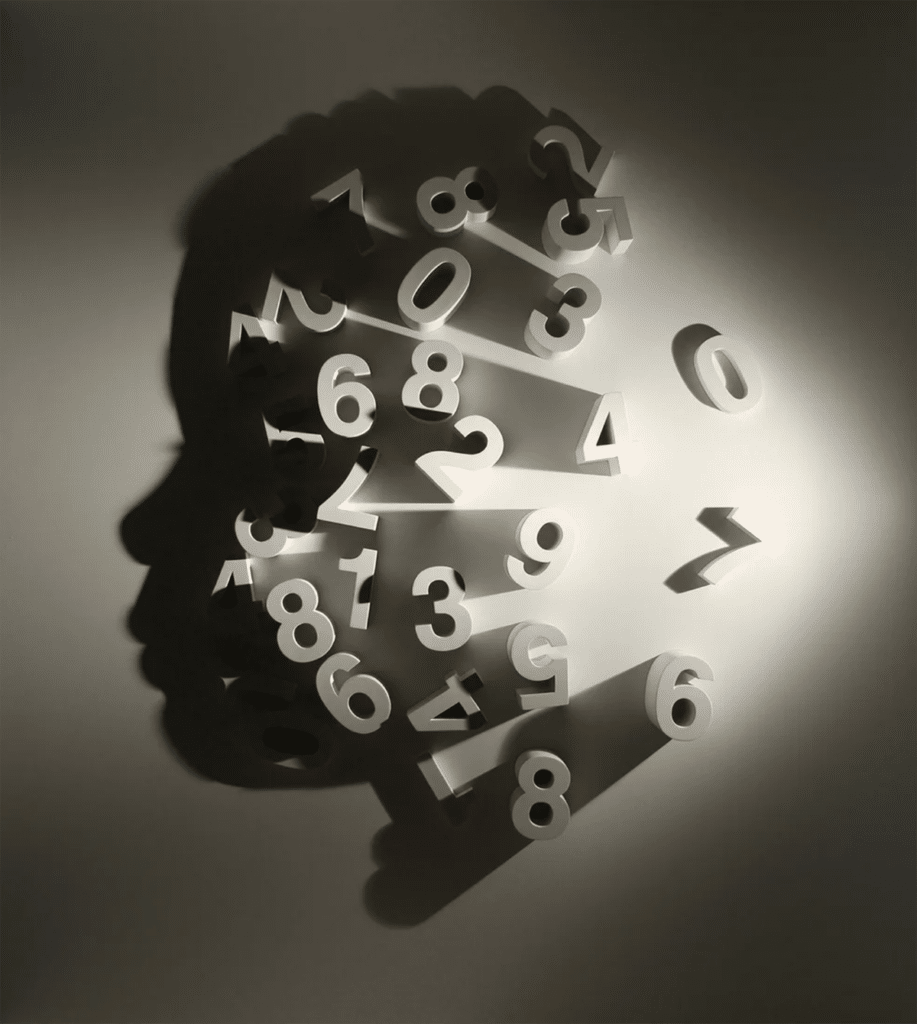
The finished sculpture may look completely unrelated to its shadow: a cluster of irregular forms could cast the profile of a face, a geometric structure could produce an organic silhouette, or a creature-like sculpture could reveal a surprisingly human figure on the wall behind it. Students can also combine sculpture and drawing by designing a shadow that completes an image already drawn on the wall or display surface.
Set up lamps or flashlights at a fixed angle and emphasize that the light source becomes part of the artwork. Students will need to observe carefully, test repeatedly, and revise their forms as they work. Along the way, they naturally engage with light direction, positive and negative shape, silhouette, projection, spatial reasoning, and iterative problem-solving. The process becomes an introduction to engineering.
3. Build a fossil for an animal that never existed.
What if students approached creature design like paleontologists instead of illustrators? Begin by asking them to invent an organism that never existed, combining anatomical traits from birds, fish, insects, mammals, reptiles, plants, humans, or deep-sea life. Instead of simply sculpting the finished creature, pose a different question: What would scientists know about this animal if all they discovered were its fossils?
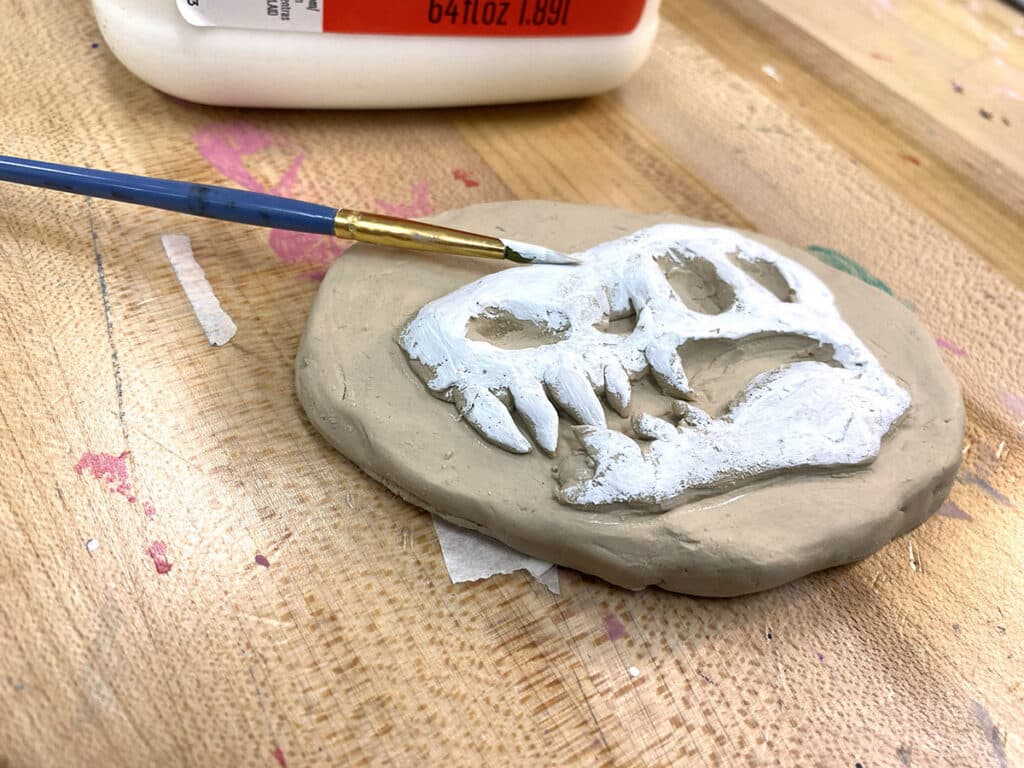
Students sculpt only selected bones or fragments in air-dry clay, then mount them on cardboard, matboard, or another sturdy backing. Students will draw missing structures directly onto the surface indicated by dotted lines, or they can leave them absent altogether. For example, an incomplete skull can invite viewers to imagine what the rest of the animal looked like. This helps it look like a real reconstructed specimen and prompts students to consider how viewers move from physical evidence to interpretation.
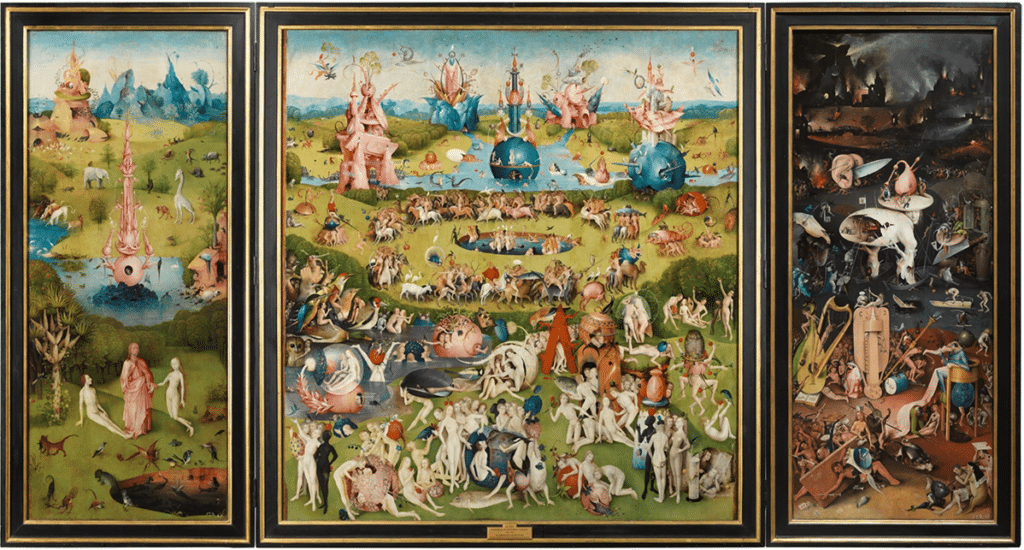
Use art history and natural history to expand this idea. The hybrid creatures of Hieronymus Bosch’s The Garden of Earthly Delights offer an entry point into impossible anatomy and imagined worlds. Medieval bestiaries, natural-history illustration, fossil reconstruction, and cabinets of curiosity can show students how humans have documented both real and invented creatures.
Push the museum-display format further by asking students to create a Latin-inspired species name, a scale diagram, a discovery location, a reconstruction sketch, a proposed diet, an extinction theory, or a single highlighted, unexplained anatomical feature. These additions turn the project into a combination of sculpture, drawing, imaginative storytelling, and scientific speculation.
For an added layer of fun, turn reconstruction into a partner activity. One student can receive another student’s completed “fossil” without seeing the original creature design. They will create a scientific reconstruction based solely on the surviving bones. Comparing that interpretation with the original imagined animal creates a memorable discussion about observation, assumption, and evidence.
4. Vary surface treatments to elevate air-dry clay.
Different surface textures can communicate different ideas. Acrylic paint followed by a water-based gloss sealant is a reliable option for finishing air-dry clay, but it is far from the only one. Apply a layer of gesso to your favorite air-dry clay project once the clay is fully dry and begin treating the sculpture like a three-dimensional canvas. Experiment with markers, watercolor, ink, collage, or other drawing materials to switch it up. Then, protect the surface with PVA glue or another compatible sealant.
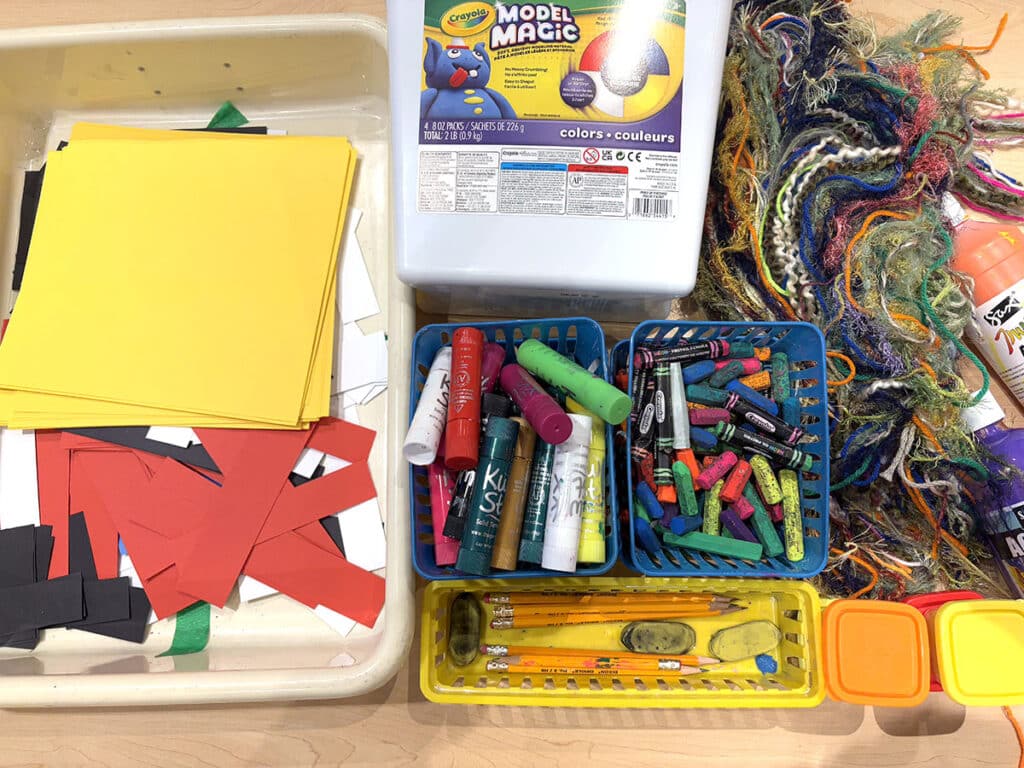
Encourage students to think of surface treatment as part of the concept rather than a finishing step. Ask: What does this surface add to the meaning of the form? A glossy finish may make an object feel manufactured, while exposed graphite can make it feel tentative or soft. Collage can introduce narrative, and visible brushwork can emphasize the hand of the maker. When students begin thinking this way, surface becomes another tool for communicating ideas rather than simply a way to “decorate” the clay.
What happens when air-dry clay refuses to stay a clay project?
Air-dry clay becomes especially exciting when we stop evaluating it according to what kiln-fired clay can do. Take advantage of the convenience of air-dry clay and elevate it with sewing, drawing, or light and shadow. Form, structure, texture, craftsmanship, scale, and surface become more than foundational skills—they transform into tools for the imagination. So, take this as your sign: consider breaking one boundary during your next clay unit and see all of the possibilities that air-dry clay can bring!
What is one material you want to try combining with air-dry clay?
Share a fun air-dry clay project idea you do in your classroom.
To chat about air-dry clay with other art teachers, join us in The Art of Ed Community!
Articles and podcasts are opinions of professional education contributors and do not necessarily represent the position of the Art of Education University (AOEU) or its academic offerings. Contributors use terms in the way they are most often talked about in the scope of their educational experiences.